

I am from Tokyo, but I love Kyoto!
If you want to forget the hectic pace of the city and spend some time in a relaxed atmosphere, why not take the plunge and jump on the Shinkansen and visit Kyoto?
This time, we would like to introduce "Gion Shirakawa," a place where you can take a breather.
Table of Contents
- What is Gion Shirakawa like? Introducing a walking route!
- My favorite spot "Tatsumi-bashi Bridge in Gion
- Tatsumi Daimyojin, a small shrine located in Gion Shirakawa
- Take a break and enjoy a sweet treat at "Gigan Komori".
- A normal passage for locals? Let's cross the "single bridge."
- summary
What is Gion Shirakawa like? Introducing a walking route!

The street facing the Shirakawa River and Shinbashi Dori at the end of Hanamikoji in the center of Gion is called "Gion Shirakawa.
The entire area including Gion Shirakawa River and Shijo Street has developed as the gate town of Yasaka Shrine since the Heian period (794-1185), and its beautiful streetscape has been designated as a traditional building preservation district.
The cobblestone-paved streets along the Shirakawa River are a charming spot in Kyoto where you can see machiya (traditional townhouses), ryotei (traditional Japanese restaurants), and quaint bridges. Visitors can stroll along the streets in a way that is not possible in Tokyo.
You usually listen to music on your headphones to get away from the hustle and bustle of the city. When you come to Gion Shirakawa, listen to the sound of the murmuring Shirakawa River. You will slowly purify your mind in the good old townscape.
There are two routes to Gion Shirakawa: northward from Gion Shijo Station on the Keihan Line and southward from Higashiyama Station on the subway, but this article will introduce the northward route.
First, let's walk to "Tea and Sake Tasuki", a store famous for shaved ice. Cross the Shirakawa River to the entrance of the store. The building has a charming atmosphere, so the entrance alone is picturesque enough to be photogenic.
Walking along the Shirakawa River, you will see the Tatsumi Bridge with its beautiful vermilion fence.
My favorite spot "Tatsumi-bashi Bridge in Gion

The bridge over the intersection of Shinbashi Street and Shirakawa Minami Street is called "Gion Tatsumi Bridge (Tatsumi-bashi). This is a classic spot in Kyoto that is often used in TV dramas, movies and commercials. It is a favorite spot of the author as well, and he takes many pictures when he comes here.
If you visit during the fresh green season, you will see the beautiful contrast between the beautiful green willows and the vermilion-lacquered fences (hedges). Cherry blossom viewing season is also recommended, as there are many cherry blossom trees.
Tatsumi Daimyojin, a small shrine located in Gion Shirakawa

http://aquadina.com/kyoto/spot/908/
On the other side of Tatsumi Bridge, there is a small shrine called "Tatsumi Daimyojin. It is said to be beneficial for the improvement of the performing arts, so you may see maiko and geiko visiting the shrine to pray for their progress.
It is also blessed with prosperity for business and is also known as "Tatsumi Inari". If you are in the Gion-Shirakawa area, be sure to pay a visit.
Take a break and enjoy a sweet treat at "Gigan Komori".

Passing Tatsumi Bridge and continuing along the river, you will see the long-established sweet shop "Gigan Komori" on the left. Take a short break in the tatami room that feels like Kyoto. The popular "Warabi Mochi Parfait" is a luxurious dish made from 100% strawbark flour, which is carefully kneaded into the rice cake. The parfait is a perfect mix of Japanese and Western flavors. The "kogashi kinako" on top of the ice cream is also fragrant and aromatic, reminding you once again of the deliciousness of kinako.
In summer, shaved ice is also very popular. Kyoto and shaved ice in summer, it is a tasteful experience.
A normal passage for locals? Let's cross the "single bridge."
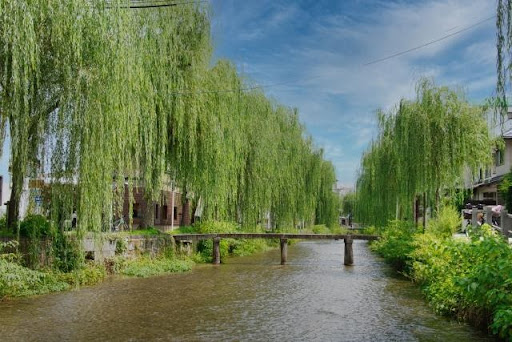
As you continue along the Gion Shirakawa River, you will see the "Ippon Bridge" (also known as "Gyoja Bridge") nestled in a row of willow trees.
Located in front of the ancient gate of Chion-in Temple, it is about 60 centimeters wide and 12 meters long. Although the bridge is barely wide enough for one person to pass, it is an essential part of daily life for the locals.
Originally, it is said that the ascetic who had completed his 1,000-day ascetic training at Ajari Shugyo on Mt. Hieizan first crossed over when entering Kyoto to report to Gensan Daishi at Sonjoin Temple in Awataguchi that he had completed his training.
There is a waterfront terrace near the bridge where you can take a break. Sitting on the bench, you can see Mt. Hiei.
summary
Gion Shirakawa was a place where one could enjoy the townscape as if time had stopped with all five senses, forgetting everyday life and feeling at peace.
When I was in Kyoto, I heard the Kyoto dialect everywhere, and even casual conversation with shopkeepers made me realize that I had really come to Kyoto.
The scenery changes again at night. The lights reflecting off the cobblestone pavement create a different atmosphere than during the day.
Why don't you forget time and relax once in a while?


Related PostRelated Articles

The signature dish at Muge Sanbo in Kyoto—the ”Ultra-Rich Matcha Parfait”—is absolutely delicious! If you want to experience the true essence of Kyoto, this is the place to go!
Have you heard of a shop called “Muge Sanbo,” whose signature dish is a parfait made with matcha that’s quintessentially Kyoto […]
"Rurouni Kenshin" Kyoto Pilgrimage to Famous Locations! List [Summary]
Have you heard of *Rurouni Kenshin*? Not only is there an anime series, but it’s also been adapted into a live-action movie starring Takeru Satoh, so you should definitely check it out […]
Who is Fujina Mi (Sannenzaka Main Store)? Her mitarashi dango are absolutely to die for♪
Have you heard of “Fujinami,” a shop famous for its mitarashi dango? Locals say this is the place to go for freshly made dango […]
A Pilgrimage to the Sacred Sites of "The Eccentric Family" in Kyoto! List [Summary]
Have you heard of the anime *The Eccentric Family*? *The Eccentric Family* is an anime adaptation of a novel by Tomihiko Morimi […]
Have you heard of “Minced Meat and Rice” in Higashiyama Ward, Kyoto? Is it true that it’s incredibly popular even though it only has one item on the menu?
Have you heard of “Hikuniku to Kome,” a famous hamburger steak restaurant in Tokyo? “Hikuniku to Kome” is a popular restaurant in Tokyo, and in 2022 […]