

Toji Temple is a World Heritage Site in Kyoto. The temple grounds are very spacious, with many buildings such as Kondo, Kodo, and Gojuno-to (five-story pagoda), and you can easily spend half a day if you want to take a good look around.
Did you know that Kanchiin, a temple associated with Musashi Miyamoto, is located near Toji Temple? Kanchiin has a deep connection with To-ji Temple and is a historic temple built around 1359. This article introduces some of the highlights of Kanchiin, which can be considered a little-known yet hidden place.
Table of Contents
- Attraction 1: Visitors can view "Eagle" and "Bamboo Forest" painted by Musashi Miyamoto.
- Highlights 2: "Chosha-no-niwa" and "Shiho-mae-no-niwa" with beautiful white sand.
- Highlight 3: Kushige Koji, a path that runs in front of Kanchiin Temple, also has a history.
- Summary: Visit "Kanchiin" together with Toji Temple!
Attraction 1: Visitors can view "Eagle" and "Bamboo Forest" painted by Musashi Miyamoto.
Although Miyamoto Musashi is famous as a great swordsman, he was actually a talented artist as well, and his ink paintings and artifacts such as saddles and wooden swords are kept in temples and museums throughout Japan. At Kanchiin, "Eagle" and "Bamboo Forest" painted by Miyamoto Musashi have been handed down, and can currently be viewed in the Upper Room of the Guest Hall.
Eagles" depicts two eagles, one on the upper right and the other on the lower left, pursuing a single prey. The bamboo in "Bamboo Grove" is highlighted at the nodes, giving the viewer the feeling of being lost in a dense bamboo grove.
The Kyakuden is registered as a National Treasure and allows visitors to appreciate the works of art in a luxurious space. When I visited, the temple was relatively empty, so I was given a detailed explanation of the paintings by a temple staff member!
Highlights 2: "Chosha-no-niwa" and "Shiho-mae-no-niwa" with beautiful white sand.
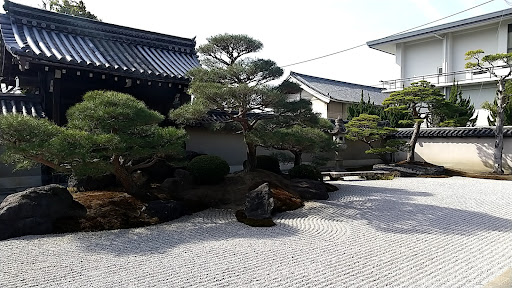
Right next to the guest house, where visitors can see the works of Miyamoto Musashi, is the Chosha-no-niwa, a dry landscape garden with plenty of pure white gravel. In the white sand, there is a raised area of moss as if it represents an island, on which pine trees are planted and stones are placed. The garden was sunny, and even in winter, we were able to relax and appreciate the beauty of the garden in the warm sunny weather.
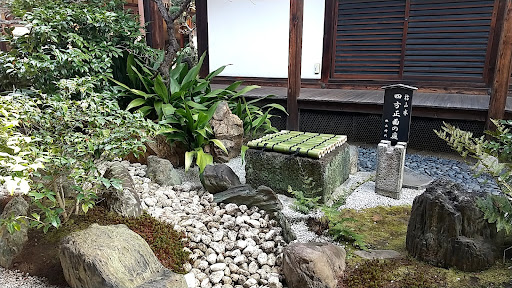
Also not to be missed is the "Shiho Shohen Garden" between the Kyakuden and the main hall. The small rectangular garden is covered with white sand, planted with maple and pine trees, and has stones and a well. The garden is said to have been modified from the Momoyama period (1573-1600) to its present form. This garden was in the shadow of the building, and the air was tense and quiet.
Highlight 3: Kushige Koji, a path that runs in front of Kanchiin Temple, also has a history.
The road that runs in front of Kanchiin Temple is called "Kushige Koji," and is the only road in Kyoto whose width has not changed since the Heian period. The distance is about 400 meters from Toji-kitaidaimon (North Gate) to the front of Kanchiin Temple.
A 10-minute walk from Kanchiin Temple is the site of the Rashomon Gate, the entrance to the Heian-kyo Capital. Visitors can ponder the history of the area and wonder if those who came all the way to the capital in the past also passed through this path.
Summary: Visit "Kanchiin" together with Toji Temple!
Kanchiin is a small temple located about a minute walk from To-ji Temple. If you wish to visit the temple in combination with To-ji Temple, we recommend that you purchase a combined ticket for To-ji Temple's Kondo and Kodo halls. The visit takes about 20 minutes, and you can enjoy a quiet and relaxing time. When you visit To-ji Temple, be sure to visit Kanchiin as well.
Kanchiin temple
Address: 403 Kujo-cho, Minami-ku, Kyoto-shi, Kyoto
Phone: 075-691-3325
HP:https://toji.or.jp/guide/kanchiin/


Related PostRelated Articles

The parfaits at FUKUNAGA901 are so cute! If you're looking for exquisite sweets at Kyoto Station, this is the place to go!
Are you familiar with “FUKUNAGA901,” a shop that’s been trending on social media platforms like Instagram and YouTube […]
Detective Conan: A Pilgrimage to the Kyoto Locations Featured in "The Crimson Love Song" and "The Crossroads of the Labyrinth"! List [Summary]
The Detective Conan movies set in Kyoto are *A Crimson Love Letter* and *Crossroads in the Labyrinth* […]
What is “Minori Cafe” in Shimogyo Ward, Kyoto? Their parfaits and desserts are delicious♡
Have you heard of a café called “Minori Café,” located right near Kyoto Station? Here, you can enjoy seasonal desserts and treats from famous shops […]
"Rurouni Kenshin" Kyoto Pilgrimage to Famous Locations! List [Summary]
Have you heard of *Rurouni Kenshin*? Not only is there an anime series, but it’s also been adapted into a live-action movie starring Takeru Satoh, so you should definitely check it out […]
"K-ON!" Kyoto Pilgrimage to the Series' Locations! List [Summary]
Have you heard of the anime “K-ON!”? “K-ON!” is a four-panel manga series by manga artist Kaki Furai […]