

It is already time for autumn leaves.
When the red colors of the autumn leaves begin to color the streets of Kyoto, many people from all over the country come to visit the city, creating an especially festive atmosphere.
Quite a number of places are well known for their autumn foliage, but there is a landscape that should be seen at the same time.
It is a gingko with golden leaves.
Do you know why ginkgo leaves turn yellow?
Yellowing of leaves is caused by changes in the pigment in the leaves as they prepare to drop their leaves for the winter.
The green color of the leaves in spring and summer is due to the presence in the leaves of a large amount of green pigment called chlorophyll, which is necessary in photosynthesis.
However, in the fall, trees stop photosynthesizing and the unwanted chlorophyll is decomposed and reduced.
As a result, the yellow pigments called "carotenoids" that remain in the ginkgo leaves stand out and the leaves turn yellow.
In this issue, we would like to introduce three of our favorite ginkgo trees in Kyoto.
Ginkgo Biloba on Shimei Dori
The first tree we will introduce is the Gingko Tree on Shimei Dori.
Shimei Dori is an east-west street in the southern part of Kita-ku, Kyoto City.
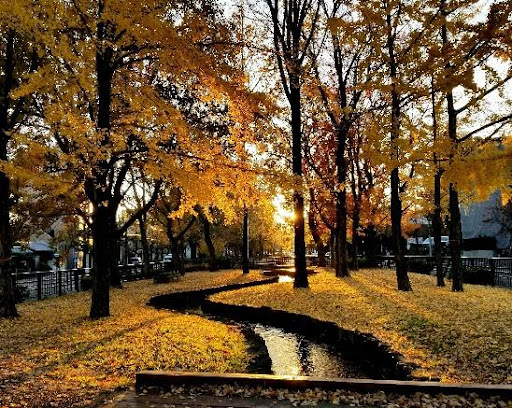
There is an intersection called Karasuma Shimei about a 5-minute walk from Kuramaguchi Station on the Kyoto Municipal Subway Karasuma Line, and to the east of the intersection is a large gingko tree with a strong presence. On the west side of the intersection, there is a sparse waterway and a row of trees.
The photo is of the scenery before dusk. I love this scene with the falling sunlight illuminating the gingko trees and the hydrophobic water, which is absolutely beautiful.
The gingko trees on the east side are also quite large, and during the "Shiki-Momiha" (not "Shiki-Momiha" in Japanese) season, the yellow world spreads out as if a large carpet were laid out, making it a spectacular sight to behold.
Ginkgo Biloba on Horikawa Dori
The next stop on the tour is the Ginkgo Biloba trees along Horikawa Dori.
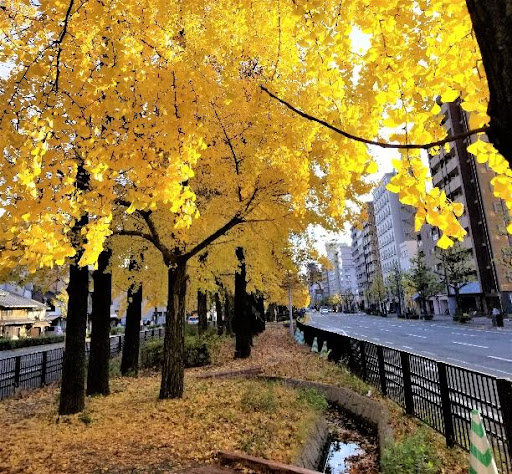
Horikawa Dori is a major street that connects the city of Kyoto from north to south.
Along the route are Seimei Shrine, Nijo Castle (a World Heritage site), and Nishi Honganji Temple.
The rows of gingko trees are located along the median strip between Horikawa-Imadegawa and Shimei-dori, and each tree is tall and has magnificent branches. If you walk along this median strip, you can see the rows of trees from below.
It is a short distance from the nearest station and is not a tourist spot, so you can enjoy the view in a relaxed manner. Words cannot fully describe the beauty of the golden leaves bathed in the morning and evening sun.
Please try to find the beauty of ginkgo trees at various times of the day.
Ginkgo Biloba in Kyoto Gyoen
Next is a gingko tree in the Kyoto Gyoen.
The photo shows a gingko tree at the site of Gyokka-do, located south of Kenreimon Gate in the Gyoen.
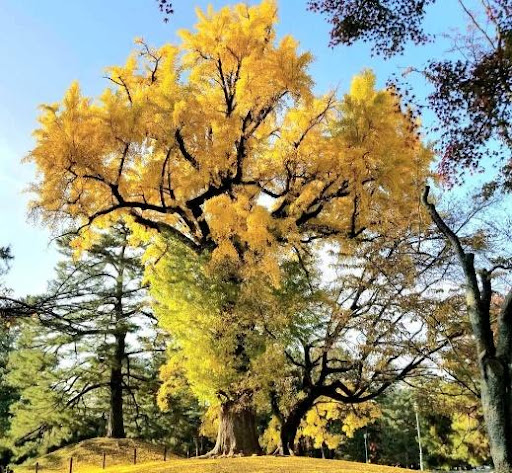
Located on a slightly elevated hill, it has a majestic appearance.
The tree is designated as the pride of Kyoto City residents and has a trunk circumference of 5.28 meters and a height of 23 meters.
The surrounding area is quite open, so from a short distance, enjoy the distant view of the entire tree and the yellow carpet in a relaxed manner.
Next is the large ginkgo tree east of the Inui Gate, the site of the Ichijo residence.
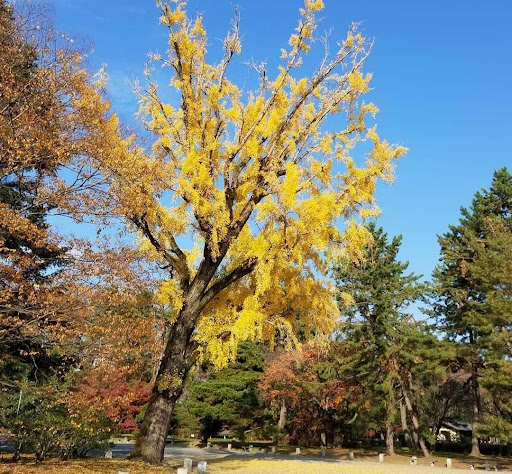
Located just inside the Inui Gate, the gingko has an overwhelming presence, yet its slightly sloping appearance makes it seem as if it is always welcoming you with a "Welcome!
The contrast with the blue of the sky is beautiful.
In addition to gingko trees, zelkova, maple, cherry, and other trees in the vast grounds are colored yellow, red, orange, and other colors, offering a different experience from the autumn foliage seen at temples and shrines.
Facility Name:Kyoto Imperial Palace
HP:https://sankan.kunaicho.go.jp/multilingual/kyoto/index.html
Address: Kyoto Gyoen, Kamigyo-ku, Kyoto-shi, Kyoto
Phone: 075-211-1215
Other Gingko Places
In addition, there are many other beautiful spots for gingko trees, including Higashi Honganji Temple, Nishi Honganji Temple, Toyokuni Shrine, Iwato Ochiba Shrine, and Kyoto Botanical Garden.
The photo shows a scene taken in 2021 at Eikando, a temple well known for its autumn foliage, where a magnificent yellow carpet spread out beneath the bright red leaves, with a variety of color variations pleasing to the eye.

Colored gingko trees can usually be seen until the end of November.
We hope you will enjoy its vivid colors in combination with the autumn leaves.


Related PostRelated Articles
What is “Fengquan,” a restaurant serving Kyoto-style Cantonese cuisine? If you’re looking for authentic flavors in Kyoto’s Nakagyo Ward, this is the place to go!
Have you heard of a restaurant called “Hōsen” in Kawaramachi, Kyoto? “Hōsen” is a restaurant where you can enjoy authentic Cantonese cuisine […]
A Pilgrimage to the Sacred Sites of *Nurarihyon's Grandson: The Thousand-Year Demon Capital* in Kyoto! List [Summary]
"Nurarihyon's Grandson," a Japanese manga by Hiroshi Shiibashi. Serialized in Weekly Shonen Jump in 2008, it features yokai as its theme […]
What is "Suehiro," the time-honored Kyoto sushi restaurant with over 200 years of history? If you're visiting Kyoto's finest restaurants, this is the place to go!
It’s no exaggeration to say that almost everyone living in Nakagyo Ward, Kyoto, has heard of the long-established Kyoto sushi restaurant “Suehiro.” This place has been featured in the media and magazines […]
A Pilgrimage to the "HELLO WORLD" Holy Sites in Kyoto! List [Summary]
"HELLO WORLD" was released on September 20, 2019. Director Tomohiko Ito is also known for *Your Name.*, but...
If you want to eat seasonal fruit tart in Kyoto! What's so special about Hyde&Away and what do you recommend?
If you like sweets, don't you sometimes have an irresistible craving for tarts? Tarts are a pastry that originated in France and are made of fruit and [...]...