

The "Gigaku Series (戯言シリーズ)" (Zarego Shiriezu) is a representative work by author Ishin Nishio, who is known for his work on Bakemonogatari.
There are six titles in all, spanning nine books, and the locations are all in Kyoto.
As a result, the locations in the work are familiar, and even if you are just beginning to read the Drama series, you will enjoy the story even more if you know them.
Therefore, in this article, we would like to provide you with detailed information on access locations and other information on Kyoto's sacred sites that appear in the works of the Drama Series.
By all means, you may want to read up on it while visiting the Holy Land.
■What is the synopsis of Kubiki Recycle: Blue Savant and the Dramatist?
In the light novel series by Nishio Ishin,
Kubiki Recycle: Blue Savant and the Writer of Nonsense
Kubi shimelomanthist
Kubitsuri High School: The Apprentice of the Juggler
Psychological (1): The Nonsense Killing of Usagi Kosuke
Psychological (2): A Towman's Little Song
Hitokui Magical: The Saginomiya Siblings of Murder and Strangeness
Nekosogi Radical (top), The Thirteenth Staircase
Nekosogi Radical (M) Red Conquest vs.
Nekosogi Radical (bottom): Blue Savant and the Nonsense Writer
The total number of works is nine in all.
Let's take a look at the synopsis of this series of nonsense.
XX Kubiki Recycle: Blue Savant and the Gigantor's Story
A conglomerate's daughter, who lives in hiding on an isolated island in the middle of the ocean, invites five women geniuses in "science, painting, cooking, divination, and engineering.
Then the chain of "isolated island x locked room x headless corpse" begins.
Can Tomo Ku Nagisa, the “blue savant,” a beautiful engineering genius girl, and her dull friend, the "gibberish user" I-chan, "prove" the genius's evil deeds?
Kubiki Recycle: A pilgrimage to the sacred places in Kyoto by Blue Savant and the Rambler 1.
Outline
The Ritsumeikan University, located in Kyoto, is the first in a series of jokes.
Ritsumeikan University is known as one of the most prestigious private universities in Kansai, right?
In the gibberish series, it appears as "Rikanukan University," which is the university attended by Ie-chan, a friend of Ku Nagisa Tomo.
At the basement cafeteria, Ie-chan had a large bowl of kimchi rice (without rice).
I would love to visit the cafeteria at Ritsumeikan University....
There are also famous sightseeing spots such as Kinkakuji Temple, Ryoanji Temple, and Ninnaji Temple in the vicinity.
Learn more about Ritsumeikan University
Ritsumeikan University is headquartered at 1 Suzaku-cho, Nishinokyo, Nakagyo-ku, Kyoto.
A well-known private university in Kansai, it was founded in 1900 by Saionji Koumou and Nakagawa Kojuro.
It has an enrollment of about 30,000 students, and not only at the Suzaku campus in Nakagyo-ku, Kyoto City, Kyoto Prefecture,
・Lake Biwa Kusatsu Campus in Kusatsu City, Shiga Prefecture, Japan
Kinugasa Campus, Kita-ku, Kyoto, Japan
Osaka Ibaraki Campus in Ibaraki City, Osaka
Tokyo Campus, Tokyo, Japan
Osaka Umeda Campus, Kita-ku, Osaka City, Osaka Prefecture
There are
Ritsumeikan University includes the Faculty of Law, the Faculty of Letters, and the Faculty of Pharmaceutical Sciences of the School of Life Sciences.
The school is crowded with many students on weekdays, so if you decide to visit as a sanctuary, please be considerate of your surroundings and behave in a respectful manner.
Address
56-1 Tojiin Kitamachi, Kita-ku, Kyoto-shi, Kyoto
Phone number
075-465-8472
How to access
Approximately 40 minutes by city bus 50 from Kyoto Station on the Kintetsu Line
○Official homepage
Kubiki Recycle: Pilgrimage to the Holy Land of Kyoto by Blue Savant and the Rogue's Wife 2.
Outline
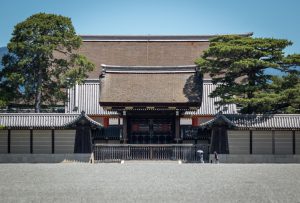
Photo: Photo AC
The "Kenreimon" is depicted when Miotsukushi Takami and Miotsukushi Misora appear.
This gate is located within the Kyoto Imperial Palace and is said to have been established around 1232.
It is the main gate of the Kyoto Imperial Palace and usually opens when the Emperor passes through or when foreign heads of state or other state guests visit.
Therefore, even if you make a general visit to the Gosho, the gates will not be opened and you will only be able to see the exterior.
The Kyoto Imperial Palace covers an expansive area of approximately 65 hectares, where some 50,000 trees grow.
The area is famous for its beautiful cherry blossoms in spring, fresh greenery in summer, and autumn foliage in fall.
Other highlights include the Oike garden, a circular garden, and the Onnaiwa, a beautiful garden with garden stones and other features.
Please also visit the famous sliding door paintings of Morodaiyu-no-Ma, Shikikan-den, and Seiryoden, where the guardian deities are said to reside.
Detailed explanation of "Kenreimon".
Kenreimon is the main gate of the Imperial Palace, located south of the Kyoto Imperial Palace.
This gate is known for its prestige, as it is not open to all, but only the Emperor, Empress, and foreign heads of state may pass through.
The Imperial Palace has different gates for different statuses, so if you are only the Empress, you must enter through a different gate.
The main street extends south from Kenreimon Gate, and this gate of the Kyoto Imperial Palace is particularly well known because it is the starting point for the Aoi Matsuri and Jidai Matsuri, the three major festivals in Kyoto.
Address
Kyoto Gyoen, Kamigyo-ku, Kyoto-shi, Kyoto
Phone number
075-211-1215
How to access
Short walk from Imadegawa Station on the Kyoto Municipal Subway Line
Kubiki Recycle: A pilgrimage to a sacred place in Kyoto by Blue Savant and the Rambler 3.
Outline
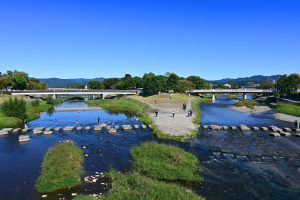
Photo: Photo AC
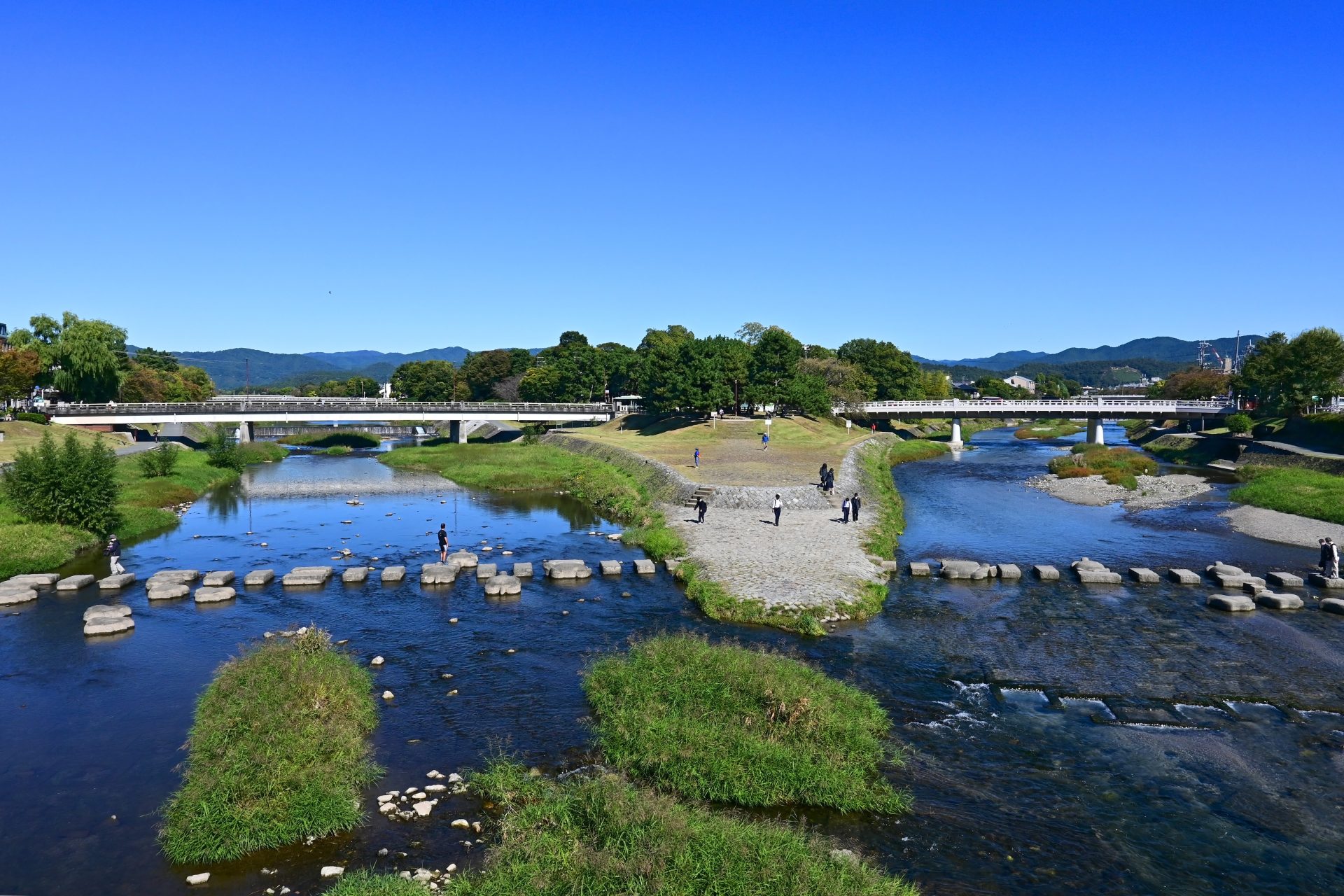
The Kamogawa River is where I met Zerozaki Hitoshiki, the man on the other side of the mirror, who first appeared in the second film in the Drama series.
Hitoshiki Zerozaki is a genuine killer with a face tattoo and a pedigree.
He has a tattoo on his right cheek, a piercing in his right ear, and a unique atmosphere.
Zerozaki and To-chan meet at the Kamogawa River.
The river becomes the Kamo River around Demachiyanagi, where it joins the Takano River, and has nurtured Kyoto's history for about 1,000 years.
In such a Kamogawa River, there is a stepping stone in the shape of a turtle called Kamogawa Delta.
○Detailed description of the Kamogawa River
The Kamo River is 23 km long.
It originates near Mt. Jashikigatake and flows north and south of Kyoto City up to the confluence of the Katsura River.
The Kamogawa River was originally opened by a Kyoto merchant named Ryoui Kadokura, who was responsible for the construction of the navigation channel.
In 1606, he began work on the Oigawa River, and also built from the Kamogawa River to the Takase River to carry out river engineering projects for riverboat transportation.
There are many dumpling shops and souvenir shops around the Kamo River, and many people enjoy eating their way to the Kamo River and other places of relaxation.
In summer, visitors can enjoy Noryo-doko (No-ryo floats) along the banks of the Kamo River, which flows through Kyoto City.
Noryokoyoko is a traditional event where visitors can enjoy tea and dumplings on a wooden deck while listening to the murmuring of the Kamo River.
Incidentally, Kamogawa Delta is also known as a sacred place for Tamako Market, Houkago Saikoro Club, Shijohan Mythology System, and K-ON! and K-ON!
Address
Tanaka Shimogamo-Miyagawacho, Sakyo-ku, Kyoto
How to access
Short walk from Demachiyanagi Station on Keihan Railway
○Official homepage
https://www.pref.kyoto.jp/kamogawa/
Related Articles
Kubiki Recycle: Aoi shiki savant to gibberish yakuwake no kyoto, holy place pilgrimage 4.
Outline
Senbon Nakatachiuri (Kyotonakatachiuri Senbon-uri) is the home of the main character, Ie-chan, and is a good place to visit on a pilgrimage to a holy place.
The streets are filled with a retro Showa-era atmosphere, and just walking around will make you feel nostalgic.
The shopping area and other areas have a Showa-era feel, but the cafes and other facilities nearby are also full of character.
It has easy access to Shijo-Kawaramachi by bus, and many students of Ritsumeikan University live here.
Also nearby are the Nishijin Textile Hall, a textile products facility, the Daisho Joyous Temple, and the Mizuha Tenmangu Shrine.
○Detailed explanation of "Senbon Neutral Selling".
Senbon Nakadachiuri Street, where Senbon Street and Nakadachiuri Street intersect.
The name comes from a situation like "Rashomon" written by Ryunosuke Akutagawa, where there was a burial ground all over the north and a thousand pagodas lined up along the road to mourn the dead.
Neutral sales were also named after the many standing vendors who did not set up stores along the street.
Address
Tamaya-cho, Kamigyo-ku, Kyoto-shi, Kyoto
How to access
Approximately 25 minutes walk from JR Nijo Station
Kubiki Recycle: A pilgrimage to the holy place in Kyoto, Kyoto City Hall
Outline
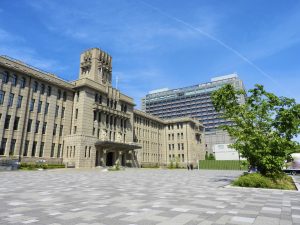
Photo: Photo AC
The place where Ee-chan and Hikari met Furuyari Zukin is the Kyoto City Hall.
The old spearhead is a "sword smith" on the fifth step of the thirteenth staircase, and his grandfather was the creator of the "lock-opening exclusive iron tool (anti-locked blade)" of Zerozaki Hitoshiki.
He looks like a normal high school student with brown hair.
Near Kyoto City Hall are the Kamo River, Honnoji Temple, Kyoto International Manga Museum, Rokkakudo, and Hotel Okura.
Learn more about Kyoto City Hall.
It is a place for everyone in the community and society to support the young and the elderly to create a beautiful and livable Kyoto.
The main building was completed in 1927.
It has a long history, having opened its doors in 1898.
Address
488 Kamihonnojimae-cho, Teramachi-dori Oike-agaru, Nakagyo-ku, Kyoto-shi, Kyoto
Phone number
075-222-3111
How to access
Approx. 10 minutes walk from Sanjo Station of Keihan Railway
○Official homepage
■ Summary
How was it?
In this issue, we have provided detailed information on access locations and other information on Kyoto's sacred sites that appear in the works of the Drama Series.
One of the highlights of Bakemonogatari is the unique characters and their relationships with each other, but you should also pay attention to the sacred sites in Kyoto!


Related PostRelated Articles
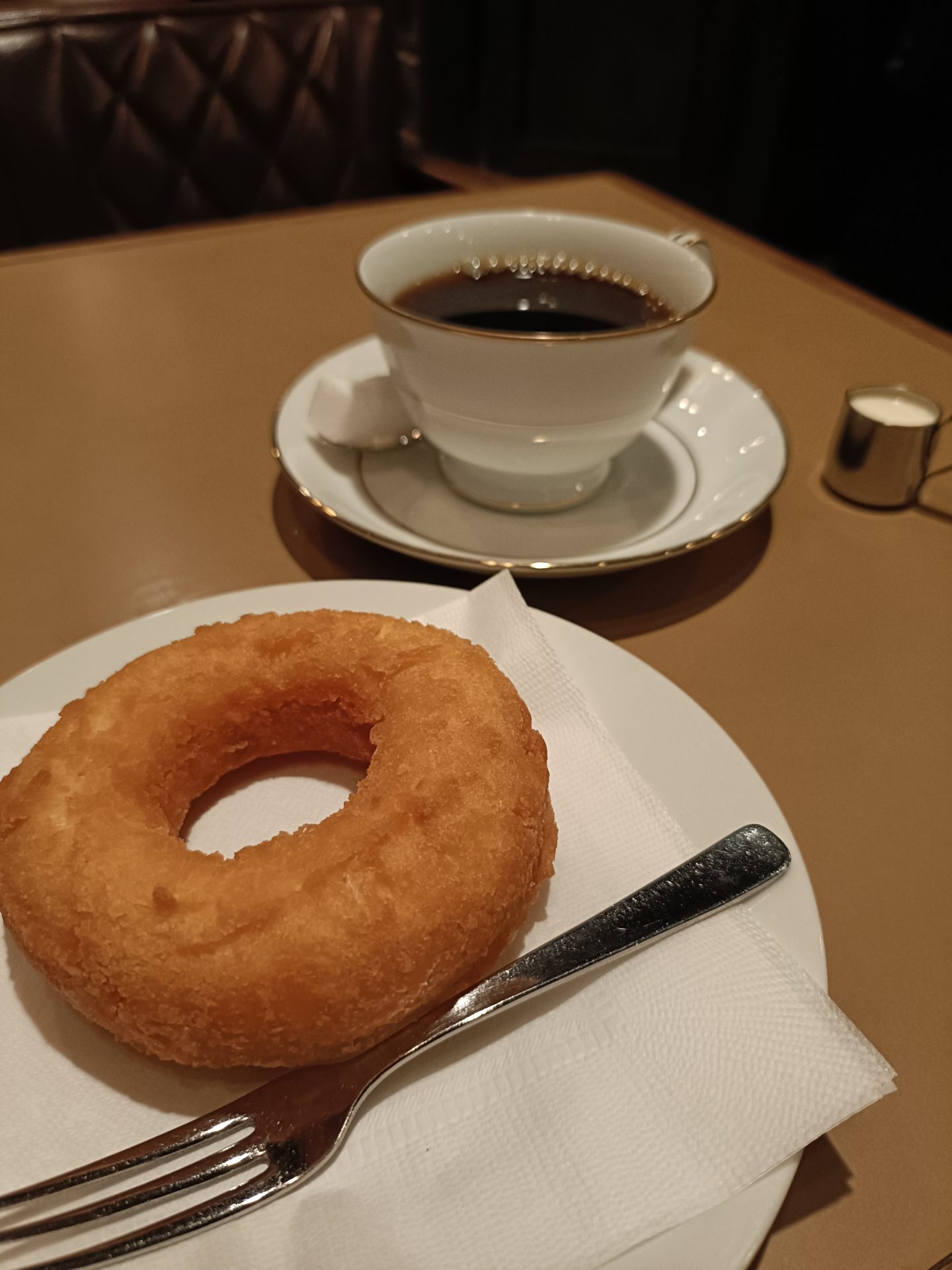
If you're going all the way, visit a place that will leave you with lasting memories! 7 Retro Cafés in Kyoto
Recently, retro-style coffee shops that make you feel as if you’ve slipped back in time to the Showa era have been attracting a lot of attention. With their vibrant colors […]

Detective Conan: A Pilgrimage to the Kyoto Locations Featured in "The Crimson Love Song" and "The Crossroads of the Labyrinth"! List [Summary]
The Detective Conan movies set in Kyoto are *A Crimson Love Letter* and *Crossroads in the Labyrinth* […]
What Is "Sawawa" in Kyoto? Discover the Charm of Matcha at Nishiki Market, with Over 1,300 Years of History!
Nishiki Market is often called the “kitchen of Kyoto,” and it’s lined with all kinds of shops, isn’t it? In a place like that, you can find drinks and ice cream made with matcha […]
"K-ON!" Kyoto Pilgrimage to the Series' Locations! List [Summary]
Have you heard of the anime “K-ON!”? “K-ON!” is a four-panel manga series by manga artist Kaki Furai […]
What is “Smart Coffee Shop,” a local favorite for many years? Their French toast is delicious!
Have you heard of a café called “Smart Coffee Shop” in Sanjo, Kyoto? It has been a local favorite for over 90 years […]