

Do you know the three festivals called "Kyoto's three major festivals"?
In Kyoto,
hollyhock festival
Gion Festival
Jidai Matsuri (Festival of the Ages)
The "three major festivals of Kyoto" are called "Kyoto's three major festivals.
The Aoi Matsuri Festival is in the season of fresh greenery, followed by the Gion Matsuri Festival, a summer tradition, and the relatively new Jidai Matsuri Festival, held in the season of reddish hues.
Each of these festivals is famous for bringing Kyoto to life, but most people are unaware of their characteristics, history, and origins.
In this article, we would like to explain the characteristics and history of the "three major festivals in Kyoto.
This article is relatively concise and is recommended for those who want to get to the point.
We hope you will learn about the history and then actually participate in the event.
■Aoi Matsuri, one of the three major festivals in Kyoto
First, let's look at Kyoto's three major festivals, the Aoi Matsuri.
○Features
Among Kyoto's festivals, this is the one that retains a dynastic flavor.
With a history of more than 1,400 years, this festival is rich in antiquity.
Dressed as a Heian aristocrat, they will go from the Kyoto Imperial Palace to Kamigamo Shrine.
○ ○ History
About 1,400 years ago, in the middle of the 6th century, during the reign of Emperor Kinmyo, a plague epidemic broke out and wind and rain caused the five grains to be unfruitful.
Therefore, at the order of the emperor (imperial command), Urabe Iyoshi Wakahiko, a worshipper of the great deity of Kamo at that time, divined that it was possessed by the deity Kamo.
The people prayed for a good harvest by running horses with bells on them on a lucky day in April, and the wind and rain subsided, the five grains grew, and the people enjoyed peace.
This event is said to be the root of the Aoi Matsuri.
○○ Period
Aoi Matsuri (hollyhock festival) is held every year on May 15.
May 1: Kamo Race Ashisha Ceremony
The horses will be checked for speed, health, and other conditions of the horses that will run in the Kamo Horse Race on May 5.
Horses are run to determine their superiority, and the horse combination for the day is decided.
May 3: Yabusame (horseback archery) ritual
In this ritual, an archer rides a horse and shoots arrows at three targets made of cedar planks every 100 meters to hit the target.
The origins of this art form can be traced back to the kishu (mounted archery) that flourished among samurai during the late Heian and Kamakura periods.
May 4: Misogi-no-Mori-no-Mori (purification ceremony for the line of women under the Saio-dai)
On an auspicious day in early May, a misogi ceremony is held for the Saio-dai and other female members of the procession.
Held alternately at Kamigamo Shrine and Shimogamo Shrine each year, this ritual is performed by about 40 women, including the Saio-dai and other female members of the procession, who purify themselves by inserting their hands into the Mitarashi Pond.
May 5: Walking and shooting ritual
Arrows are shot at Shimogamo Shrine to pray for festival safety.
It is believed to have originated as a gratuity ceremony held at court during the Heian period (794-1185).
May 5, Kamo Horse Race
Kamigamo horse races are held at Kamigamo Shrine.
It is said to have originated in 1093, when a horse race was offered to Kamigamo Shrine to pray for a bountiful harvest during the Heian period.
May 12: Goyin Festival
This ritual welcomes the divine spirit of the Aoi Matsuri from the Goin Shrine at the western foot of Mount Hiei.
It will be held at Shimogamo Shrine.
May 15: Aoi Matsuri (hollyhock festival)
It consists of the rite of the roadside, the rite of the shrine, and the rite of the palace.
In the rite of roji, the Yamashiro-ji, Saio-ji and female attendants walk from Kenreimon to Kawaramachi Dori and Shimogamo-jinja Shrine in this order.
The Shashino-no-gi ceremony is performed at both Kamigamo and Shimogamo shrines.
When the procession arrives at Shimogamo-jinja Shrine, the ritual text is dedicated and the To-Yu is offered.
○ Location
The festival will be held at Shimogamo-jinja Shrine and Kamigamo-jinja Shrine.
■The Gion Festival, one of Kyoto's three major festivals
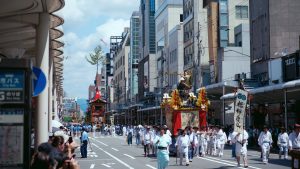
Photo: KYOTREAT Editorial Department
Next, let's take a look at Kyoto's three major festivals, the Gion Matsuri.
○Features
The festival takes place over the month of July.
The festival is a memorial service to pray for the repose of the plague and good health, and is famous for the parade of Yamahoko floats.
Food stalls will be lined up on July 15 and 16, attracting many people.
The festival is famous for Yoiyama (Mt. Yoiyama) on July 14-16, Mae-matsuri (festival before the festival) Yamahoko-junko on July 17, and Gosai (festival after the festival) Yamahoko-junko on July 24.
○ ○ History
In 869 (Jokan 11) during the Heian period (794-1192), a plague was spreading, killing many people not only in Kyoto but throughout the country.
It is believed that the plague was caused by the hauntings of grudge spirits who died with a grudge against this world, and the Gion Goryokai was held to enshrine Ushitotenno to pray for the banishment of the plague and for good health and good fortune.
This is said to be the origin of the Gion Festival.
○○ Period
The Gion Festival is held annually from July 1 to 31.
Particularly famous are the following
July 14-16 Yoiyama
Many people come to Shijo Street.
Food stalls will be lined up for the two days from the 15th to the 16th, and many people come to enjoy the festive atmosphere.
July 17: Yamaboko Junko (float parade)
The Yamaboko procession is one of the most exciting events of the Gion Festival.
Twenty-three floats lead the procession, with the naginoko floats in the forefront.
The sight of the huge floats moving forward amidst the sounds of Gion music is a sight to behold.
July 24: Yamaboko Junko (float parade)
Shijo-dori and Oike-dori streets are closed to traffic and crowded with people.
Yamaboko floats walk to Shijo-Karasuma.
○ Location
The festival will be held at Yasaka Shrine, Shijo-Kawaramachi and Karasuma-Oike area.
■The Jidai Matsuri, one of Kyoto's three major festivals
Finally, let's look at Kyoto's three major festivals, the Jidai Matsuri.
○Features
This is a relatively new festival compared to the Aoi Matsuri and Gion Matsuri.
A parade of period costumes and implements of each period will walk in the parade.
The highlight of the tour is the transition from one era to another: Meiji Restoration, Edo, Azuchi-Momoyama, Muromachi, Yoshino, Kamakura, Fujiwara, Enryaku...
It is 2 km long and has more than 2,000 participants.
○ ○ History
In 1895, the 1,100th anniversary of the relocation of the capital to Heian-kyo was celebrated, and Heian Shrine was built with Emperor Kanmu as its deity.
The festival originated as a commemorative festival that was held over two days from October 22 to 24, 1895.
○○ Period
The Jidai Matsuri is held annually from October 15 to 23.
October 15: Counsellor's Certificate Conferral Ceremony
About 500 selected Kyoto citizens will pray before the deity for the safe progress of the festival.
October 21, the day before the festival
The priesthood passes on meat and other food.
October 22: Shinko Matsuri
The imperial carriage, the Emperor's vehicle, is transferred to the shrine and departs from the main shrine.
October 22nd: Period customs procession
This is the so-called Jidai Matsuri.
The 2-km procession takes about 2 hours to walk from Kenreimon-mae of the Kyoto Imperial Palace to Heian Jingu Shrine.
Please look at them with a sense of each era.
October 23: Later Festival
The ritual equipment is being cleaned up.
○ Location
Heian Shrine
■ Summary
How was it?
In this issue, we have introduced the characteristics, history, and origins of the three major festivals in Kyoto.
If you know the history and origin of the three major festivals in Kyoto, you will be able to enjoy them from a different perspective.


Related PostRelated Articles
If you're going all the way, visit a place that will leave you with lasting memories! 7 Retro Cafés in Kyoto
Recently, retro-style coffee shops that make you feel as if you’ve slipped back in time to the Showa era have been attracting a lot of attention. With their vibrant colors […]
What’s so special about the luxurious tsukesoba at “Shamihōan” in Kyoto’s Higashiyama Ward? A historic restaurant with 161 years of history
"Shamihōan" has been a local favorite for over 100 years. This is a place where soba lovers can enjoy a meticulously crafted flavor that’s simply irresistible […]
The signature dish at Muge Sanbo in Kyoto—the ”Ultra-Rich Matcha Parfait”—is absolutely delicious! If you want to experience the true essence of Kyoto, this is the place to go!
Have you heard of a shop called “Muge Sanbo,” whose signature dish is a parfait made with matcha that’s quintessentially Kyoto […]
Detective Conan: A Pilgrimage to the Kyoto Locations Featured in "The Crimson Love Song" and "The Crossroads of the Labyrinth"! List [Summary]
The Detective Conan movies set in Kyoto are *A Crimson Love Letter* and *Crossroads in the Labyrinth* […]
"Rurouni Kenshin" Kyoto Pilgrimage to Famous Locations! List [Summary]
Have you heard of *Rurouni Kenshin*? Not only is there an anime series, but it’s also been adapted into a live-action movie starring Takeru Satoh, so you should definitely check it out […]