

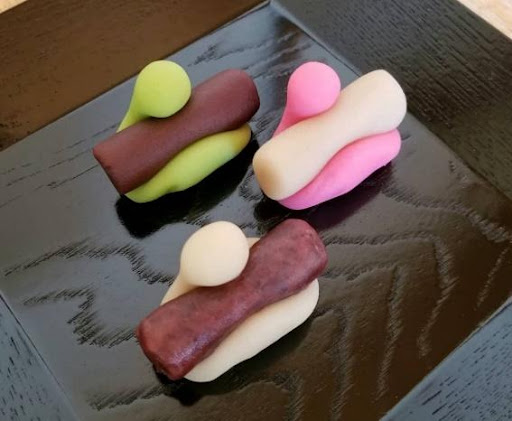
New Year's Day and Setsubun have passed, and Valentine's Day has come to an end. Then the next seasonal event that comes to mind is the Hinamatsuri (Girls' Festival). However, many people may wonder if there is anything special about Hinamatsuri in Kyoto...? I am sure there are many people who wonder what is special about the Hinamatsuri in Kyoto.
In this article, we would like to introduce some Japanese sweets that are indispensable for Hinamatsuri in Kyoto. Generally, hishimochi (water chestnuts) and hina-arare (rice cakes for the Girls' Festival) come to mind, but in Kyoto, it is different.
Here is that candy, Hiki-Chikiri!
Origin of Hichirigiri
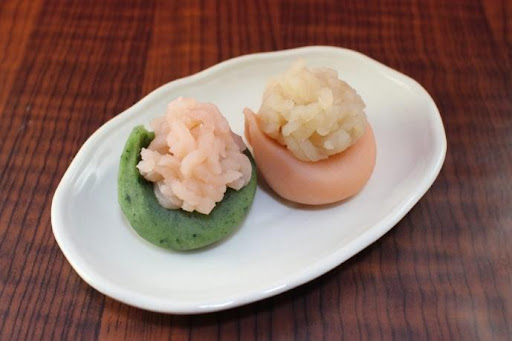
Hichigiri is said to have originated in the Heian period (794-1185) ritual of Itadakimochi, in which a mochi (rice cake) was placed on the head of a child on New Year's Day to celebrate his or her future. The rice cake used in this ceremony was a round rice cake with red bean paste placed in a hollow in the center.
The shape of hichigiri is similar to that of dai-mochi, a rice cake made of yomogi-mochi in the shape of a ladle, with azuki bean paste placed in a hollow in the center. The handle of the ladle shape is like a torn corner, as the name "hichigiri" implies.
Modern Tear-offs
Now, instead of rice cakescarriage (e.g. of one's body)(Mix white bean paste with flour and other ingredients, steam, add sugar, and fir.carriage (e.g. of one's body)The ladle is made of white, red, and tansy, and topped with red bean paste or kinton.
There is a reason why the three colors of green, white, and peach were chosen. There are various theories, but it is said that green is to ward off evil (sprouts), white is for the prosperity of offspring (snow), and peach is to ward off evil (peach blossoms).
Come to think of it, water chestnuts also come in these three colors.
Kyoto's wagashi stores express their originality through the strange combination of these ingredients.
Shioyoken's "Hiki-Senkiri

Let us introduce Hiki-Senkiri from Shioboken, established in 1882. Located in the Nishijin area, about a 15-minute walk from Imadegawa Station, this long-established Japanese confectionery store was once used as a model for a morning TV drama.
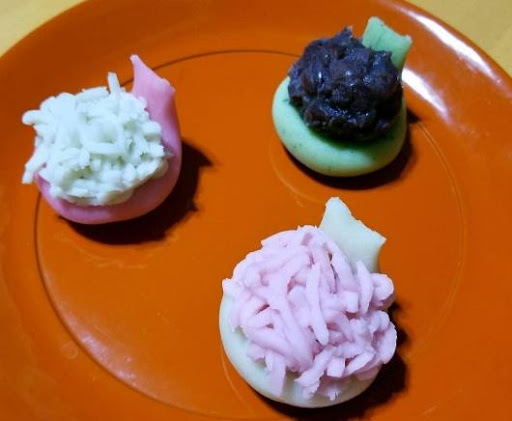
The pink konashi is decorated with white kinton, the white konashi with pink kinton, and the konashi with yomogi is decorated with grains of sweet bean paste. Most Japanese confectionery stores offer two colors, but this one has three colors. It is gorgeous and spring-like, isn't it?
Akoya" in the tasting room of the tasting room of the tasting room of the tasting room of the tasting room of the tasting room

Next is the "Akoya" from Ohgetsu. Ohgetsu is a Japanese confectionery store founded in 1916 by the first generation who trained at Toraya.
The restaurant does not display pre-made items on the shelves, but rather by reservation only, so that customers can enjoy the freshly prepared items as much as possible.
It is made with three colors of konashi, with the green konashi combined with azuki koshi-an, the white with azuki nuriman, and the pink with white azuki koshi-an.
The koshi-an is very smooth and fine, and its refined taste spreads in the mouth.
Grain bean paste retains the texture of the azuki bean skin and has a rich azuki bean flavor. It is a perfect match for the mochi, which is soft and chewy!
The shape is truly reminiscent of an Akoya shell, and is one of the unique characteristics of the store.
summary
This year, why not get Hiki-Chigiri and enjoy a Kyoto-style Hinamatsuri?


