

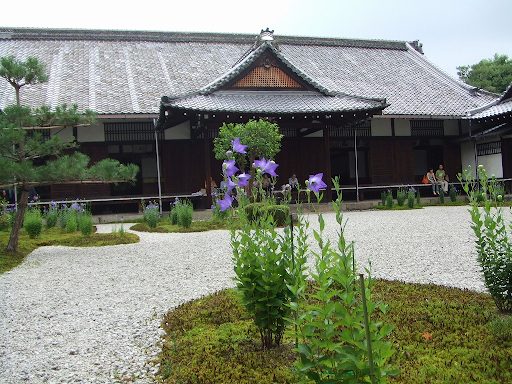
Kikyo (bellflower) has impressive petals in cool colors such as blue, white, and light purple. In Kyoto, these flowers bloom from summer to fall, and just looking at them makes one feel refreshed.
In this article, we will introduce two temples in Kyoto where you can view Kikyo (Chinese bellflowers). Enjoy the view of Kikyo from inside the building where a soft breeze blows through the air.
Table of Contents
■Lushan Temple
■Tentokuin era (957.10.27-961.2.16)
■summary
■Lushan Temple
Rozan-ji Temple is located on Teramachi-dori, east side of Kyoto Gyoen. It was founded in the Tenkei era (938-947) by Ryogen Genzan Daishi, the 18th head of the Tendai sect of Hieizan.
It stands almost on the same spot where Murasaki Shikibu, the author of The Tale of Genji, lived in his mansion, and the Genji garden can be admired from the main hall.
Kikyo are planted in the Genji garden. They grow only where moss is planted, so they look like islands of Chinese bellflowers floating in the sea. Don't miss the view where sunlight reflects off the white sand and illuminates the bellflowers, making the light purple petals appear more vivid. You can admire them to your heart's content by sitting on the porch of the main hall.
In addition to the Tale of Genji, Rozan-ji Temple is dotted with other historical spots, such as the Godoi Palace built by Toyotomi Hideyoshi and the burial site of Emperor Keikou in the 18th century. Visitors can also experience sutra copying, making this temple a must-see for history buffs.
Facility Name:Lushan Temple
HP:http://www7a.biglobe.ne.jp/~rozanji/index.html
Address: 397 Kitanobe-cho, Teramachi-dori Hirokoji-agaru, Kamigyo-ku, Kyoto 602-0852
Phone number: 075-231-0355
■Tentokuin era (957.10.27-961.2.16)
Tendokuin" is a temple of the Rinzai sect located near Tofukuji Temple. It was founded in the Nanbokucho Period and prospered as one of the five pagodas of Tofukuji Temple. Although the temple once fell into disrepair, it was restored in the 1600s. Its abbot, Bun'ei Seihan, was highly respected by Toyotomi Hideyoshi, and as a learned priest of his son, Hideyori, he had a firm relationship with the authorities of the time.
Today, the temple is famous for its bellflowers, and purple and white bellflowers are planted on the grounds. The contrast with the lush moss covering the entire garden is so beautiful that you will want to keep looking at it. You can also admire the blue maple trees from the garden, and the breeze blowing through the building creates a comfortable space. Take your camera in moderation and enjoy the quiet and luxurious time.
The Kikyo (Chinese bellflowers) at Tendokuin can only be viewed during the special viewing period held every summer. Depending on the blooming conditions of the bellflowers, the garden is open to the public for a limited period of about three weeks from the end of June to mid-July. For an extra fee, you can sit on the veranda and admire the garden while enjoying matcha green tea and Japanese sweets. Be sure to check the official website.
Facility Name:Tentokuin era (957.10.27-961.2.16)
HP:https://tentokuin.jp/
Address: 15-802 Honmachi, Higashiyama-ku, Kyoto, 605-0981, Japan
Phone number: 075-561-5239
■ Summary
Kikyo, or Chinese bellflower, has a refreshing color that is perfect for summer. Sitting on the porch and admiring them while feeling the cool breeze is somehow calming. Both temples are visited from indoors, so it is possible to experience the Kyoto-like atmosphere while preventing heat stroke. They are easily accessible from popular sightseeing spots such as the Kyoto Imperial Palace and Tofukuji Temple, so be sure to stop by when you travel.


Related PostRelated Articles

The signature dish at Muge Sanbo in Kyoto—the ”Ultra-Rich Matcha Parfait”—is absolutely delicious! If you want to experience the true essence of Kyoto, this is the place to go!
Have you heard of a shop called “Muge Sanbo,” whose signature dish is a parfait made with matcha that’s quintessentially Kyoto […]
"Rurouni Kenshin" Kyoto Pilgrimage to Famous Locations! List [Summary]
Have you heard of *Rurouni Kenshin*? Not only is there an anime series, but it’s also been adapted into a live-action movie starring Takeru Satoh, so you should definitely check it out […]
Who is Fujina Mi (Sannenzaka Main Store)? Her mitarashi dango are absolutely to die for♪
Have you heard of “Fujinami,” a shop famous for its mitarashi dango? Locals say this is the place to go for freshly made dango […]
A Pilgrimage to the Sacred Sites of "The Eccentric Family" in Kyoto! List [Summary]
Have you heard of the anime *The Eccentric Family*? *The Eccentric Family* is an anime adaptation of a novel by Tomihiko Morimi […]
What is “Fengquan,” a restaurant serving Kyoto-style Cantonese cuisine? If you’re looking for authentic flavors in Kyoto’s Nakagyo Ward, this is the place to go!
Have you heard of a restaurant called “Hōsen” in Kawaramachi, Kyoto? “Hōsen” is a restaurant where you can enjoy authentic Cantonese cuisine […]