

Recently, retro-style coffee shops that make you feel as if you’ve slipped back in time to the Showa era have been attracting a lot of attention.
This shop, where you can enjoy nostalgic café classics—such as vibrantly colored cream sodas, firm, rich puddings, classic firm puddings, parfaits topped with red cherries, and egg sandwiches—has become extremely popular as a place where you can relax while still experiencing a sense of escapism.
If you’re visiting during a limited amount of time on your trip, you’ll want to go to restaurants and cafes that offer something you can only experience there, right? You don’t want to waste a single meal.
Actually, Kyoto is a city with plenty of retro coffee shops like that.
In the early Showa period, cafes featuring in-house roasted coffee and European-style interiors began to appear, becoming new havens of relaxation. Kyoto’s café culture was built as artisans from traditional industries, self-employed professionals, university professors, writers, and college students gathered there.
So, in this article, we’ll introduce seven unique retro coffee shops that you should definitely visit if you’re in Kyoto.
"Café Hisui": Enjoy a leisurely time that feels like you've slipped back to the Showa era
First up is “Hishui,” a traditional coffee shop founded in Showa 36. It’s located a little less than a 10-minute walk from Kitaoji Station on the municipal subway line. It has been featured on TV shows numerous times and has even served as a filming location for a drama. It’s one of the most iconic retro coffee shops in Kyoto.
Various elements—such as the three stripes in light blue, blue, and red adorning the solid concrete facade, the tiles and food displays on the entrance wall, and the words “Coffee and Meals” on the glass door—combine to create a retro atmosphere.
The interior features a calm, spacious atmosphere with chic wood accents throughout. The ornately decorated lighting is truly luxurious! And the four-seater sofas, adorned with charming, elegant floral embroidery, are neatly arranged in rows.
When you sit down, it's even softer than you'd expect! It's so comfortable that you'll find yourself staying there longer than you intended.
Some of the tables even feature old arcade machines. So nostalgic!
With box seats, counter seats, and round tables that can accommodate large groups, it’s great that the space can be used for a variety of purposes.
Business hours are from 9:00 a.m. to 9:00 p.m. (until 8:00 p.m. on Sundays only). You can enjoy breakfast from 9:00 a.m. to 11:00 a.m.
There are three options in total: the Toast Breakfast, the Sandwich Breakfast, and the Hot Dog Breakfast. The drink menu features a variety of options, including blended coffee, black tea, Coca-Cola, and grapefruit juice.
I recommend the Sandwich Breakfast Set. The ham sandwich features thick slices of ham and cucumber that pair perfectly with spicy mayonnaise, and the salad comes with egg salad—boiled eggs tossed in mayonnaise—which you can also use to make your own egg sandwich.
Another highlight is the extensive food menu. It includes bread items like pizza toast and mixed sandwiches; set meals such as simmered fish, miso tonkatsu, and sirloin steak; and light meals like beef curry, yakisoba, and Napolitan spaghetti. There’s such a wide variety that you’ll want to give up trying to list them all.
When it comes to classic retro dishes, omurice is definitely the quintessential choice.
This omelet rice is just so huge. It feels really heavy when you pick up the plate (lol).
This ketchup rice, wrapped in a thin omelet, is packed with ingredients like green peppers and sausages, offering a gentle, comforting flavor.
The secret to the flavor is our homemade demi-glace sauce★ Because we’re committed to making everything from scratch, it’s rich and full-bodied yet not at all heavy—you’ll find yourself eating more and more.
It comes with coleslaw and soup as side dishes, which is a nice way to take a break from eating—that’s a plus!
The dessert lineup features a star-studded cast!
The “Fruit Parfait” features vanilla ice cream topped with sliced oranges, apples, kiwis, and bananas, along with orange sauce. It’s packed with fresh fruit, plenty of whipped cream, and a generous amount of orange sauce bursting with fruity flavor. It’s a dreamy dessert that lets you enjoy a variety of flavors, ensuring you’ll savor every bite without ever getting bored.
In addition, they offer a wide variety of items—including pancakes, coffee jelly, Ogura Sandy, and pudding à la mode—that will leave you spoiled for choice.
With such an extensive menu, you’re sure to be thoroughly satisfied no matter what time of day you go or who you go with. Plus, since it’s a spacious venue, you can relax and take your time without worrying about the clock. Come enjoy a leisurely time in this calm, retro atmosphere.
- ■Hishui Coffee Shop
- Address: 41-2 Murasakino Nishigoshoda-cho, Kita Ward, Kyoto City
- Phone: 075-491-1021
- Official Website/ https://caffe-0201.com/access/
- Official Instagram / https://www.instagram.com/hisui_titi/
"Kissa Hanano Ki": A classic coffee shop beloved by countless stars
Next up is "Kissa Hanano Ki," a long-established coffee shop founded in 1966.
Located near the Karasuma-Shimei intersection, about a 5-minute walk from Kuramaguchi Station on the City Subway Karasuma Line.
The contrast between the red and black of the tent is eye-catching.
The moment you step inside, it’s like entering a completely different world from the laid-back residential neighborhood outside. A spacious, antique-style interior unfolds before you. Apparently, the inspiration for opening the café came from the first owner’s desire to recreate in Japan the kind of café he had encountered in France.
The floor features a bold checkerboard pattern, creating an energetic and modern look.
Believe it or not, the table is made of copper. It has been polished to a shine and radiates an elegant glow.
A variety of stylish and distinctive lighting fixtures are placed throughout the space, adding even more character to it.
And actually, I’ve heard that the actor Ken Takakura used to be a regular here. There’s a large panel of the French film actor Jean Gabin displayed at the back of the counter, and I’ve been told that it was a gift from Ken Takakura.
In addition, a photo of Ken Takakura is displayed at the seat that was his favorite.
The menu is exactly what you'd expect from a classic coffee shop.
The menu features coffee-based drinks like hot coffee, Wiener coffee, and café au lait—and believe it or not, there’s even something called “Wiener tea.” The hot coffee has a robust flavor with a distinct, rich bitterness. The menu also includes banana juice, soda floats, toast, and croissants.
For lunch, the menu features curry rice, hayashi rice, mixed sandwiches, dry curry, and Italian spaghetti, among other items. It’s said that Ken Takakura used to enjoy the curry rice here often. It’s packed with finely chopped vegetables and has a gentle sweetness. The Hayashi rice has a rich, deep flavor that makes you think it must have been simmered slowly. It’s also generously loaded with meat. Perhaps the secret to its enduring popularity lies not only in the wonderful atmosphere but also in its extensive menu selection.
Spend a relaxing moment in this extraordinary space—beloved by the great actors of the Showa era—where classical music plays softly in the background.
Why not give it a try?
- ■Hana no Ki Coffee Shop
- Address: 32-8 Koyama Nishihanaike-cho, Kita Ward, Kyoto City
- Phone: 075-432-2598
"Café Soirée": Lose Yourself in a Mysterious World of Blue
Next up is “Café Soir,” a spot that frequently graces the covers of guidebooks and continues to draw attention with its never-ending lines.
It's about a 1-minute walk from the "Kawaramachi" Station on the Hankyu Kyoto Line. It's located just off Kiyamachi-dori, which runs north along the Takase River from Shijo-dori.
The restaurant was founded in 1948 (Showa 23), shortly after the war. The name is said to derive from the French word “Soirée,” which means “evening gathering” or “evening party.”
The exterior, with its wood and white walls, has a slightly Tyrolean feel. The display window decorated with coffee cups is quintessentially Showa-era retro. The wooden transom-like sections feature intricate carvings of grapes and other fruits. It is said to have been built with a French church as its inspiration.
To the left of the entrance door hangs a framed copy of a poem by Isamu Yoshii—a member of the nobility during the Taisho and Showa periods who was also active as an author, poet, and screenwriter—that reads, “Since that evening when I was overcome by the aroma of coffee, I have become one who dreams.” This piece bears witness to the establishment’s long history.
As soon as you step inside, a world of blue unfolds before you, creating a truly mysterious and fantastical atmosphere.
According to the official website, this blue lighting was adopted after the founder’s friend, dyeing researcher Rokuro Uemura (former director of the International Museum of Dyeing and Textiles and professor at Osaka University of Arts), advised him at the time of the store’s opening, saying, “Blue light makes women look beautiful and men look youthful, so why not use it for the store’s lighting?” Apparently, the shop was even used as a venue for arranged marriage meetings back then.
Grape-motif carvings are featured throughout the interior, and numerous original paintings by Seiji Togo are also on display. Togo was a Western-style painter who took the postwar art world by storm as a master of depicting beautiful women during the Showa era. The sweet, feminine figures—hailed as “Seiji’s Beauties”—and the lyrical atmosphere lend the interior a dreamy, languid feel.
The founder, Mr. Motoki, was a collector of Mr. Togo’s artwork, and eventually Mr. Togo himself began visiting the shop. Mr. Togo took a liking to the shop and reportedly painted pictures specifically for it; even today, his artwork adorns coasters, tumblers, and cups, further enhancing the shop’s retro atmosphere.
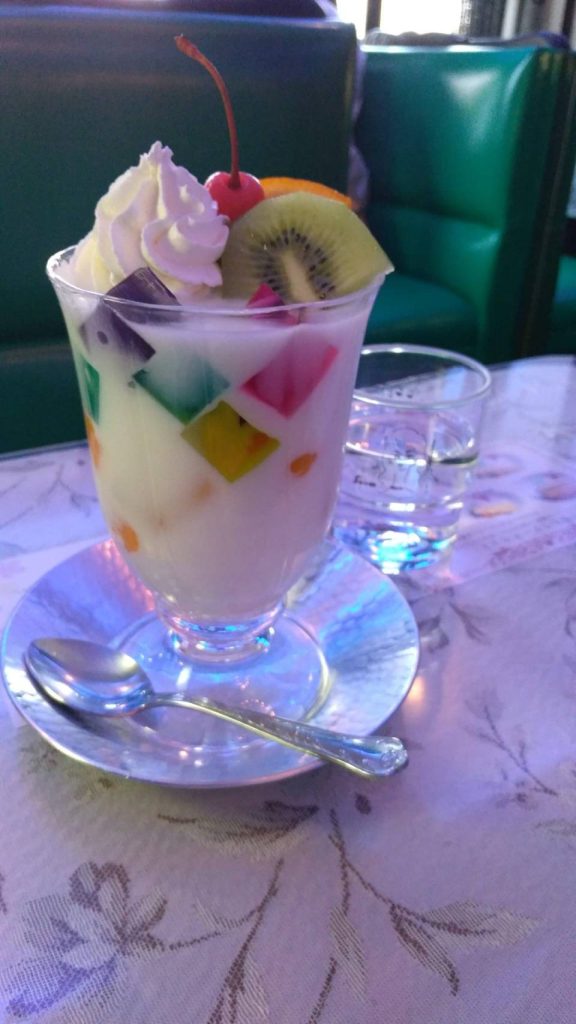
The signature dish here is, without a doubt, the “Jelly Punch.” It was created in 1975 by the wife of the second-generation owner, who wanted to attract not only men but also women to the shop. Jellies in various colors—red, purple, light blue, and yellow—float in soda, creating a scene that looks just like stained glass.
This soda was launched in 1889 and is said to be lightly carbonated, made using the same production method for over 100 years. With its gentle fizz and mild sweetness, it has been loved by people of all ages for many years.
In addition to “Jelly Punch,” there are also “Jelly Milk,” “Jelly Yogurt,” “Jelly Punch Float,” “Jelly Wine,” “Jelly Coffee,” and “Jelly Coffee Float.” The menu also includes coffee, hot chocolate, cake, toast, and other café items, as well as cocktails.
We also offer cream sodas topped with rich vanilla ice cream. Orange, Violet, Lemon, and Sky Blue.
The appeal lies in its six colors—Luu, Strawberry, and Melon—and its diverse lineup.
It’s nice to immerse yourself in a space brimming with nostalgic charm and a sense of escapism, and let your thoughts wander back to the Showa era when cultural figures gathered here.
Shin.
- ■Café Soirée
- Address: 95 Manmachi, Nishikiyamachi-dori, Shijo-agaru, Shimogyo-ku, Kyoto
- Phone: 075-221-0351
- Official Website/ https://www.soiree-kyoto.com/
- Official Instagram / https://www.instagram.com/tea_room_soiree/
"François Café"—The First Café in Japan to Be Designated a Tangible Cultural Property
Next up is “Francois Café,” one of Kyoto’s most iconic retro cafés.
If you walk a short distance south along the Takase River from the western end of Shijo-Kobashi, you’ll come across a striking white building adorned with elegant stained glass and streetlights.
Founded in 1934, it is said to have served as a social hub at the time, attracting painters and literary giants who gathered there to engage in lively discussions. In January 2003, this building became the first coffee shop in Japan to be designated as a National Registered Tangible Cultural Property.
I’ve heard that the shop’s name, “François Café,” was inspired by the French painter François Millet.
The founder was Shoichi Tateno, who was a student at an art school at the time. Influenced by a senior student he admired, he became involved in the labor movement and, with the goal of supporting activists’ self-sufficiency and promoting socialism, opened a coffee shop in 1934.
The interior is designed in the Italian Baroque style, evoking the grand halls of a luxury cruise ship. The white domed ceiling, opulent chandeliers, and stained-glass windows create a unique atmosphere, and stepping into the space—where classical music plays—feels as if you’ve stepped back in time.
Back when François first opened, the walls were adorned with reproductions of famous paintings that the founder, Mr. Tateno, had collected—works he particularly loved. These included François Millet’s *The Sower* and *The Gleaners*, Leonardo da Vinci’s *Mona Lisa*, Vermeer’s *Girl with a Pearl Earring*, and Botticelli’s *Spring* and *The Birth of Venus*. To this day, these paintings continue to adorn the interior of the store.
The menu is typical of a traditional coffee shop. One of the signature items is the Wiener coffee. It offers a gentle, delightful flavor where smooth whipped cream, a subtle bitterness and acidity, and just the right amount of sweetness blend together. The cups also have a retro feel to them.
One of my personal favorites is coffee jelly. It has a perfectly soft, melt-in-your-mouth texture, with a rich, bitter flavor and a fragrant aroma. You can adjust the sweetness and creaminess to your liking by mixing in as much vanilla ice cream as you prefer. Coffee jelly, which offers a wonderful harmony with ice cream, is truly a hidden classic on the menu.
Be sure to check out the “Special Pudding” as well. In 2021, to coincide with the “Kyoto: Modern Architecture” exhibition held to commemorate the first anniversary of the Kyocera Museum of Art’s opening, a dish from the old menu was recreated and has since become a staple on the menu.
This firm-textured pudding has a rich, deep flavor of eggs and vanilla. It’s topped with a slightly bitter caramel sauce, lightly sweetened whipped cream, and homemade orange confit—which offers a unique fresh tartness and crisp texture—allowing you to enjoy a variety of flavors, aromas, and textures in a single dish.
This rare cheesecake is incredibly rich! Enjoy the melt-in-your-mouth harmony of Danish cream cheese and fresh cream.
Start by eating it as is, then gradually mix in the blueberry sauce to enjoy the different flavors.
Although it’s a very traditional coffee shop, it stays open relatively late into the evening. Why not enjoy it for a wide range of occasions, from breakfast to dinner and even a late-night stop after a night out?
- ■Francois coffee shop
- Address: 184 Funado-cho, Shimogyo-ku, Kyoto (south of Shijo on Nishikiyamachi-dori)
- Phone: 075-351-4042
- Official Website/https://francois1934.com/
- Official Instagram / https://www.instagram.com/francois1934kyoto/
"Tsukiji": An overwhelming sense of nostalgia evoked by its stately presence
The next shop I’d like to introduce is also one of Kyoto’s most iconic coffee shops.
Founded in 1934, the restaurant is housed in a two-story Western-style building tucked away in a back alley just off the bustling streets of Kawaramachi. The colorful tiles on the walls are particularly eye-catching, and a sign reading “Tsukiji” hangs on the railing of the second-floor balcony. It is said that the founder, who once aspired to be an actor, chose this name after the “Tsukiji Small Theater” in Tokyo.
It is said to be the first shop in Kyoto to serve Wiener coffee, and it has become the restaurant’s signature dish.
As soon as you step inside, you’ll see the double spring-loaded doors you’ve seen in Western movies. When you push them open with both hands, a world completely different from the hustle and bustle of the Kawaramachi area unfolds before your eyes—a space brimming with exotic charm.
The interior is filled with the stately atmosphere created by the collection of the original owner. Oil paintings, wooden reliefs, decorative plates, and clocks line the walls, and the air is filled with the solemn sounds of classical music. It feels as if you’ve wandered into a world completely separate from the outside.
If you order “hot coffee” here, you’ll be served—believe it or not—a Wiener coffee. “Huh? Doesn’t ‘hot’ usually mean drip coffee?” I thought to myself as I stared at the server, but they calmly served me a Wiener coffee—hot coffee topped with whipped cream—and I was genuinely surprised at first. It’s a truly unique coffee shop where “drip coffee” isn’t even on the menu.
Viennese coffee first began to be served immediately after the end of the war.
Back in the days when supplies were scarce, many shops used low-quality cream that wouldn’t foam even when whipped, whereas we’ve always used high-quality cream that foams up beautifully, which has earned us great acclaim. We use deeply roasted beans with a rich flavor that pairs perfectly with our rich, subtly sweet cream!
The menu is refreshingly simple, offering only cakes—no light meals. The signature dish is the mousse cake. Inside the not-too-sweet mousse, enveloped in white, fluffy, and smooth cream, you’ll find pieces of fruit. It’s also served with blueberry sauce, which adds a delightful accent to both the flavor and texture. With a cherry perched on top, its adorable appearance is as graceful as a princess.
Why not pay a visit to experience a sense of the extraordinary, as if you’ve slipped back in time to the early Showa era?
- ■Tsukiji
- Address: 384-2 Yoneya-cho, Nakagyo Ward, Kyoto City
- Phone: 075-221-1053
"Smart Coffee Shop": Hotcakes with a warm, comforting flavor and our signature house-roasted coffee
The next shop is “Smart Coffee Shop.” It’s located in the Teramachi Specialty Store Association shopping district, where antique shops and Japanese stationery stores line the street. It’s just a 1-minute walk from Kyoto City Hall Station on the Tozai Subway Line and a 5-minute walk from Keihan Sanjo Station—so it’s very accessible!
It opened in 1932 as the “Smart Lunch Room.” After the war, it became a coffee shop.
The name "Smart" reflects our commitment to providing "thoughtful service."
The large coffee grinder on display really catches your eye and builds your anticipation for a delicious cup of coffee.
The interior is reportedly inspired by a Swiss mountain cabin, and the warm, inviting atmosphere—created by the extensive use of wood and brick—is sure to put you at ease. With classical music playing in the background, it’s a space that caters to a variety of needs, whether you’re enjoying desserts with someone or reading a book on your own.
The standout feature here is, without a doubt, the in-house roasted coffee. A large German-made roaster takes pride of place at the entrance.
We use five types of beans—from Colombia, Brazil, Ethiopia, Indonesia, and the Dominican Republic—and our original blend is formulated to bring out the unique characteristics of each. We let the blend rest for at least two days to consistently recreate the flavor of “Smart Coffee.”
They use a flannel filter for their drip coffee. Apparently, after brewing, they let it sit for about five minutes to allow the flavors to meld before serving. This supposedly helps prevent the flavor from changing too much, resulting in coffee that tastes great even when it cools down. It’s a unique flavor you can only find here, where you can truly sense the shop’s dedication to achieving a perfect balance between bitterness and acidity.
The restaurant's signature dishes are pancakes, French toast, and homemade pudding.
The pancakes, in particular, have a very simple flavor and have been a favorite since the company was founded.
I’ve heard that many famous people, including the legendary Hibari Misora, used to enjoy this dish. Apparently, many regulars order it for breakfast.
The ingredients are simple—eggs, milk, sugar, flour, baking powder, and flavoring—and the recipe used by the founder’s wife (the current owner’s grandmother) is still used today.
Mixing the batter, letting it rest for a while, and then baking it on a thick griddle causes it to rise nicely and results in a uniform thickness.
When you let it soak up plenty of our homemade syrup—with just the right amount of sweetness—a sense of pure bliss will wash over you.
It's the kind of dish that makes you feel a sense of nostalgia when you eat it.
French toast is also a very popular breakfast item.
The outside has a crispy texture and is cooked to perfection. A subtle aroma of butter wafts up. When you cut into it with a knife, the inside is light and fluffy.
First, try it as is to savor the subtle sweetness of the dough itself. Next, drizzle it generously with maple syrup—you’ll be filled with an indescribable sense of happiness.
This pudding is a classic, old-fashioned style with a slightly firm texture. It has a rich egg flavor, and the subtly sweet caramel sauce adds depth to the taste. Order it with a cup of coffee and take your time savoring how well they complement each other.
Also, reflecting the recent egg sandwich craze, these egg sandwiches are gaining popularity.
The bread is from Shinshindo, a famous bakery in Kyoto. It’s spread with butter and mustard. Then, a piping-hot rolled omelet—seasoned only with salt and quickly grilled at a high temperature—is sandwiched inside! It’s so delicately delicious that you’ll find yourself devouring it in no time (lol).
What's more, during lunchtime, you can also enjoy authentic Western-style cuisine on the second floor.
The menu features lunch sets and à la carte options, but we recommend the “Smart Lunch,” which comes with two main dishes!
With choices like cream croquettes, fried shrimp, hamburger steak, chicken cutlet, and the “Dish of the Day,” it’s hard not to be spoiled for choice. Plus, the prices are reasonable.
It can get a little crowded on some days, so we recommend visiting early in the day.
Actually, there’s also a “Smart Coffee Shop: Uzumasa Branch,” and since it’s close to the film studio, you might even spot some celebrities there.
At all of these places, the coffee and food are of high quality, and they continue to uphold traditional recipes and styles. Be sure to stop by at least once to soak up the nostalgic atmosphere.
- ■Smart Coffee Shop
- Address: 537 Tenseiji-mae-cho, Teramachi-dori Sanjo-agaru, Nakagyo-ku, Kyoto
- Phone: 075-231-6547
- Official Website/ https://www.smartcoffee.jp/
- Official Instagram / https://www.instagram.com/smartcoffee_kyoto/
"Rokuyosha Basement Store": A Pioneer in In-House Coffee Roasting. Savor the Perfect Pairing of Coffee and Handmade Donuts
Last but not least, we’d like to introduce “Rokuyosha Basement Store,” which was founded in 1950.
Although it’s located on the southeast corner of Kawaramachi Sanjo—one of Kyoto’s most bustling commercial districts—once you descend the stairs leading underground, you’ll find yourself in a chic and serene world of its own.
Its roots trace back to the street-side coffee stand that the founder, Minoru Okuno, opened in what was then Manchuria.
The interior design is inspired by a luxury cruise ship. Every element—from the elegant camel-colored leather sofas reminiscent of a ship’s interior to the warm wooden counters and walls, and the modern chandeliers—is simple yet exudes an authentic feel. Green Kiyomizu-yaki tiles add a chic touch to the walls.
All of our coffee is made from beans we roast in-house. We can be considered pioneers in introducing in-house roasted coffee to coffee shops.
I’ve heard that they still carefully roast the beans in small batches using a 3-kilogram roaster at the owner’s parents’ home. Apparently, the 3-kilogram batch size makes it easier to adjust the heat and allows them to keep a close eye on the beans as they roast.
We offer a selection of coffees from various regions, including dark roast, medium-dark roast, medium roast, and light roast. We grind the beans to order and serve each cup brewed one at a time using the pour-over method. Our blend features a rich, deep flavor with a pleasant, robust bitterness.
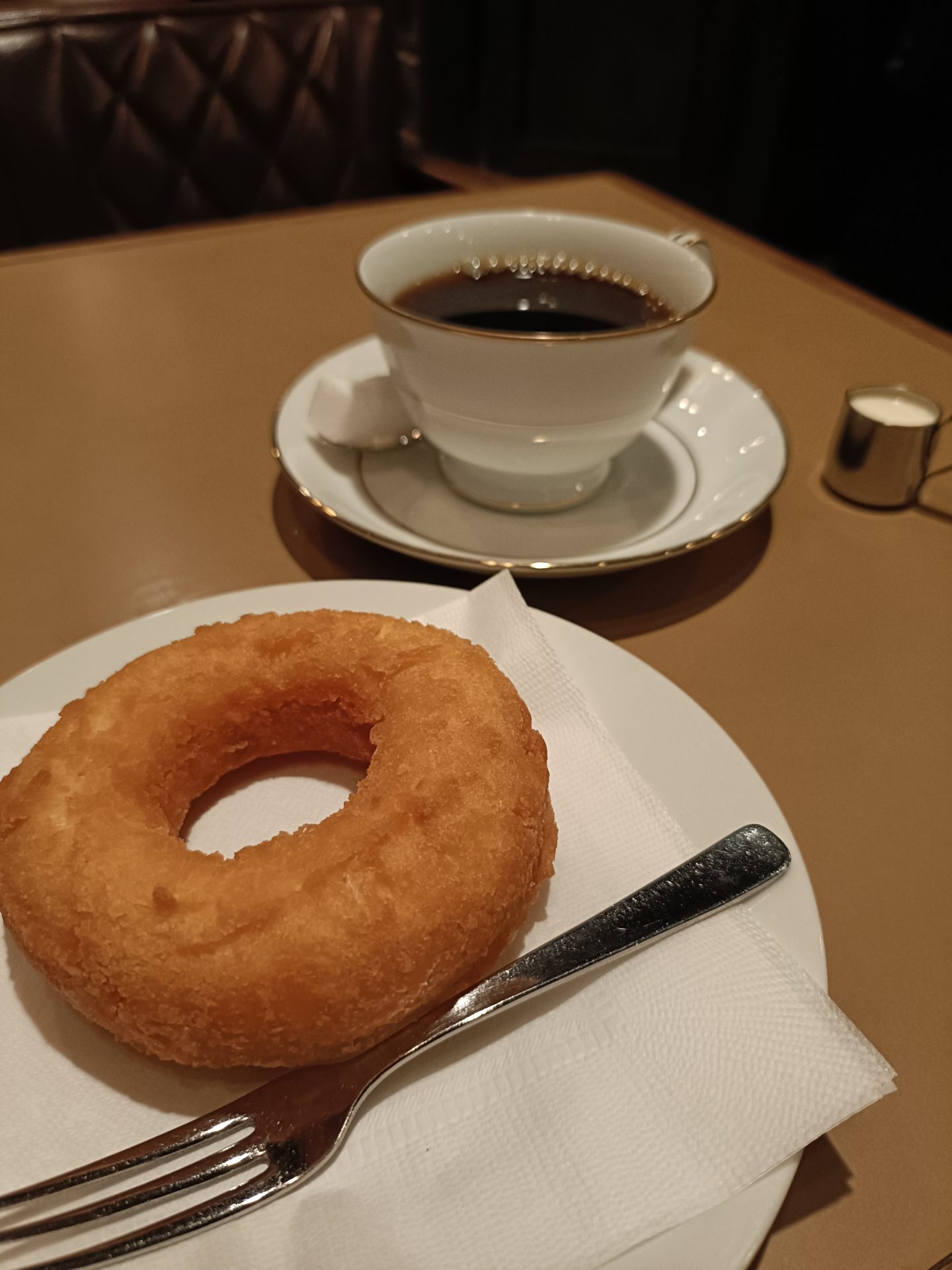
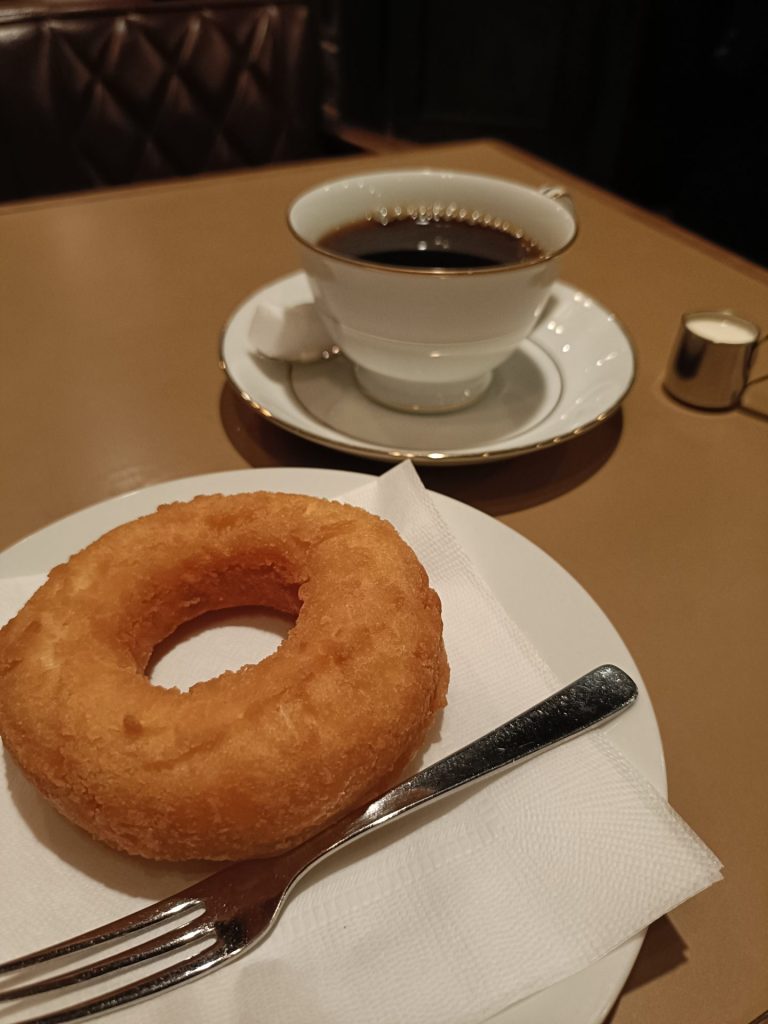
The donuts, which are handmade right in the store, are also very popular. When you order one, it’s reheated before being served; the texture is crispy on the outside—reminiscent of sata andagi—and moist on the inside. They’re not too sweet and have a simple, wholesome flavor.
It’s served starting at noon and ends when it runs out, so if you absolutely want to try it, be sure to come early! ♪
In 1968, the store expanded to the first floor; smoking is permitted on the first floor, but not in the basement.
The first floor offers breakfast service (8:30 a.m.–12:00 p.m.), and the basement features bar hours (6:00 p.m.–11:00 p.m.).
There are different types of coffee available as well. On the first floor, in keeping with the desire to preserve the “taste of coffee from a traditional coffee shop,” only the original blend is served—brewed in a 10-cup cloth filter.
Since the son runs the first floor and the father runs the basement, it’s fun to compare the different atmospheres and the taste of the coffee.
- ■ Roku-yo-sha Basement Store
- Address: B1F, 36 Daikoku-cho, Kawaramachi Sanjo-sagaru, Nakagyo-ku, Kyoto City
- Phone: 075-241-3026
- Official Website/ https://rokuyosha-coffee.com/
There are still many more unique retro coffee shops in Kyoto that we weren’t able to cover in this article.
Why not spend some quality time at a café that catches your eye and experience the relaxing atmosphere that has been loved for generations?
Shall we?


Related PostRelated Articles
Enjoy a cup of coffee in the retro atmosphere of “Kaze to Coffee” in Kyoto’s Kamigyo Ward… Are the accompanying sweets tempting?
There are many tourist spots in Kyoto, but perhaps some of you would like to take a break from the bustling atmosphere from time to time […]
Detective Conan: A Pilgrimage to the Kyoto Locations Featured in "The Crimson Love Song" and "The Crossroads of the Labyrinth"! List [Summary]
The Detective Conan movies set in Kyoto are *A Crimson Love Letter* and *Crossroads in the Labyrinth* […]
"Rurouni Kenshin" Kyoto Pilgrimage to Famous Locations! List [Summary]
Have you heard of *Rurouni Kenshin*? Not only is there an anime series, but it’s also been adapted into a live-action movie starring Takeru Satoh, so you should definitely check it out […]
What Is "Sawawa" in Kyoto? Discover the Charm of Matcha at Nishiki Market, with Over 1,300 Years of History!
Nishiki Market is often called the “kitchen of Kyoto,” and it’s lined with all kinds of shops, isn’t it? In a place like that, you can find drinks and ice cream made with matcha […]
"K-ON!" Kyoto Pilgrimage to the Series' Locations! List [Summary]
Have you heard of the anime “K-ON!”? “K-ON!” is a four-panel manga series by manga artist Kaki Furai […]