

Kyoto is now in the season of fresh greenery and hydrangea with vivid colors. In this issue, we will guide you to the Kyoto Botanical Garden, which is perfect for such an outing season! You can enjoy a variety of plants all year round, so if you want to feel nature in Kyoto, please visit the Botanical Garden♪.
Table of Contents
What is Kyoto Botanical Garden?
◆Access from Kitayama Station on the municipal subway.
◆Flowers of the four seasons
◆Greenhouse
◆Cornus trees
◆ Summary
What is Kyoto Botanical Garden?
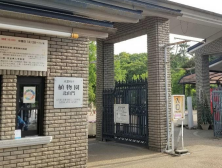
Located in the Kitayama area in the northern part of downtown Kyoto, the Kyoto Botanical Garden is Japan's oldest public botanical garden, opened in 1924.
Although few tourists may come only for the botanical garden, it is relatively close to the World Heritage sites of Kamigamo Shrine and Shimogamo Shrine, and is easily accessible from Kitaoji Station, one stop from which a bus bound for Kinkakuji Temple leaves.
Approximately 12,000 species of plants are planted and exhibited on the vast grounds. The concept of the botanical garden is "the most interesting and relaxing botanical garden in Japan," and the atmosphere is relaxing.
The park is also home to a playground with playground equipment, which neighborhood children call "Osumo Park" because of its sumo-like statue of a sumo wrestler.
◆Access from Kitayama Station on the municipal subway.
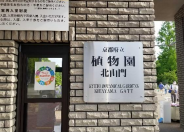
If you are traveling by train, it is convenient to get off at Kitayama Subway Station and enter through Kitayama-mon Gate, just outside Exit 3.
By car, it takes about 45 minutes from the Kyoto Minami Interchange on the Meishin Expressway. It is recommended to enter the park from the main gate, where parking is available nearby.
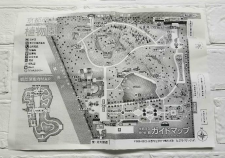
A guide map of the park is available at the entrance.
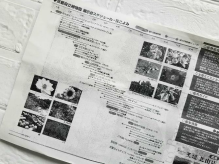
There is also a "Hanagoyomi" that describes what flowers are in bloom at what time of the year. Once you have these two items, you can go to the flower spots you want to see!
◆Flowers of the four seasons
In early May when the author visited, the most impressive thing was the rose garden♪ The rose garden is a Western-style garden with a view of Mount Hiei in the distance. Many early-blooming roses were in full bloom.
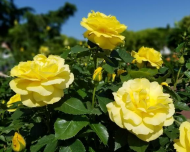
Among them, I was particularly attracted to the yellow rose named "Freesia. The clear yellow color was very vivid, and its gorgeous fragrance was impressive! About 2,000 roses of about 300 varieties are cultivated, and there were also many roses in bud, so it seems that there are many more roses to enjoy (please check the official website before visiting).
And the author recommends the hydrangea and lotus in the coming season. The photo was taken in 2020, and the hydrangea garden is located near the center of the east side of the garden. The best time to see hydrangeas in the Botanical Garden is usually around early June to early July. About 200 varieties of hydrangeas are planted in the garden, including Gaku-hydrangea, Yoh-hydrangea, and Yama-hydrangea. Each variety has its own unique color and shape and is a sight to behold.

And the lotus season is usually from early July to early August. The photo shows the lotus pond at Hankiike Lotus Pond, where the oriental lotus "Ogura no Akebono" is in full bloom.
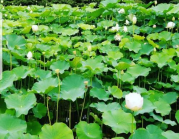
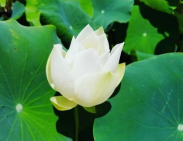
In addition, there are many potted plants at Shikisai-no-oka, and about 180 kinds of lotus are grown there.
It is not easy to see lotuses blooming in the pond up close, but since they are potted, you can see a variety of colors, sizes, and blooms at close range, so you can take good photos for your Instagram.
◆Greenhouse
One of the largest viewing greenhouses in Japan is also a highlight of this botanical garden.
The exterior design was inspired by the silhouette of the Golden Pavilion floating on a pond and the Kitayama mountain range. Once inside, visitors can enjoy the Desert Savanna Room, Greenhouse Jungle Room, and 25,000 tropical plants of about 4,500 varieties from all over the world. Although there is a fee (200 yen for adults, 150 yen for high school students), it is worth visiting at least once to see rare plants such as the rare baobab tree and the "three sacred trees of Buddhism" (muyuju, indobodaiju, and sara sangju), which are all three species. It is worth a visit!
◆Cornus trees
The author's favorite part of the botanical garden is the row of Japanese cypress trees. Located in the southern part of the garden, the avenue of more than 100-year-old camphor trees planted when the garden first opened stretches approximately 200 meters in an east-west direction, and is well known for its appearance in Kawabata Yasunari's novel "Ancient Capital". On a clear day, the sunlight shining through the trees in the green tunnel is fantastic, and you can feel a sense of calmness as you walk along.

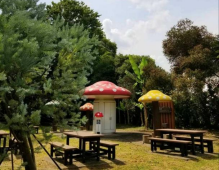
In addition, there is something that looks like a mushroom object in the park! It is actually called "Mushroom Library," and its official name is "Heian no Sato Kodomo Bunko Mushroom no Ie. When you open the door, you will find a book inside.
There are four mushrooms in all, and they are filled with illustrated books and picture books. On weekends, many parents and children can be seen spreading out books at nearby tables and benches. It is a luxury to be able to relax and enjoy books in the midst of nature.
◆ Summary
Don't you think you would like to visit? In spring, 450 cherry trees of 150 varieties bloom in profusion, and in fall, you can enjoy the natural beauty of the autumn leaves. Why not visit the Botanical Garden while strolling along the Kamogawa River or in the Kitayama area, and enjoy the seasonal changes in the garden?
Facility name: Kyoto Botanical Garden
Address: Shimogamo-Hangi-cho, Sakyo-ku, Kyoto
Access: Kyoto Municipal Subway Kitayama Station (Exit 3) or Kitaoji Station (Exit 3), 10 min. walk to the east.
HP:https://www.pref.kyoto.jp/plant/


Related PostRelated Articles

Detective Conan: A Pilgrimage to the Kyoto Locations Featured in "The Crimson Love Song" and "The Crossroads of the Labyrinth"! List [Summary]
The Detective Conan movies set in Kyoto are *A Crimson Love Letter* and *Crossroads in the Labyrinth* […]
"Rurouni Kenshin" Kyoto Pilgrimage to Famous Locations! List [Summary]
Have you heard of *Rurouni Kenshin*? Not only is there an anime series, but it’s also been adapted into a live-action movie starring Takeru Satoh, so you should definitely check it out […]
"K-ON!" Kyoto Pilgrimage to the Series' Locations! List [Summary]
Have you heard of the anime “K-ON!”? “K-ON!” is a four-panel manga series by manga artist Kaki Furai […]
A Pilgrimage to the Sacred Sites of "The Eccentric Family" in Kyoto! List [Summary]
Have you heard of the anime *The Eccentric Family*? *The Eccentric Family* is an anime adaptation of a novel by Tomihiko Morimi […]
A Pilgrimage to the Sacred Sites of *Nurarihyon's Grandson: The Thousand-Year Demon Capital* in Kyoto! List [Summary]
"Nurarihyon's Grandson," a Japanese manga by Hiroshi Shiibashi. Serialized in Weekly Shonen Jump in 2008, it features yokai as its theme […]