

Rokkakudo is a must-see when visiting Kyoto.
Rokkakudo is located on the east side of Karasuma-dori to Rokkaku-dori and is visited by many tourists as a power spot.
As its name suggests, Rokkakudo is a hexagon-shaped temple with a deep history and charm.
Therefore, we would like to introduce the history, highlights, and attractions of Rokkakudo.
Table of Contents
What is Rokkakudo, Kyoto? History of Rokkakudo
■Highlights and attractions of Rokkakudo, Kyoto
■ Summary
What is Rokkakudo, Kyoto? History of Rokkakudo
First, let's look at the history of Rokkakudo in Kyoto and the origin of its name.
What is Rokkakudo in Kyoto?
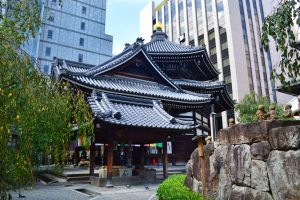
Photo: Photo AC
Rokkakudo," the main hall of the temple, is shaped like a hexagon.
Its official name is Shiyunsan Dingbo-ji Temple, and it is a monolithic temple of the Tendai lineage.
This is where Prince Shotoku came in search of lumber to build Shitennoji Temple in Osaka in 587.
A spring was gushing in this vicinity, and Prince Shotoku attempted to purify himself.
He placed the statue of Nyoirin Kannon that he was carrying among the branches and it did not move away from him. I want to build a temple to save the people.
Therefore, Prince Shotoku built a hall there, which is said to be the origin of Rokkakudo.
The hall was subsequently rebuilt in 1877 and designated as a Tangible Cultural Property of Kyoto.
Today, the temple is also a pilgrimage site for the 33 temples of Saigoku and Rakuyo, and the "navel stone" on the temple grounds, which will be introduced later, is very famous.
Why is Rokkakudo hexagonal?
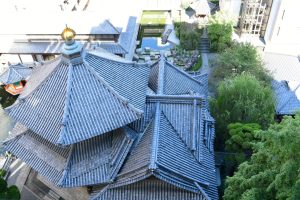
Photo: Photo AC
Rokkakudo" is characterized by its hexagonal roof.
The hexagonal shape is said to have been created by the wish that the six desires arising from the eyes, ears, nose, tongue, body, and will be eliminated, and that the horns be removed and the body be made whole.
In the precincts of the temple, visitors can see Taishido Hall, where Prince Shotoku is enshrined, and other ancient sites.
■Highlights and attractions of Rokkakudo, Kyoto
Here we introduce the sights and attractions of Rokkakudo in Kyoto.
Fat: Ancient site of Prince Shotoku's bathing
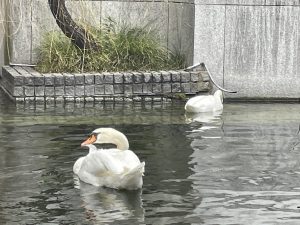
Photo: Photo AC
In the precincts of Rokkakudo, there is a pond where Prince Shotoku bathed.
It is called the ancient site of Prince Shotoku's bathing, and don't miss the place where the pond is divided into squares by stones, as it is said to be the place where he bathed.
Also, there are swans in the pond all year round, so if you are lucky, you may be able to see them.
Fat Navel Stone
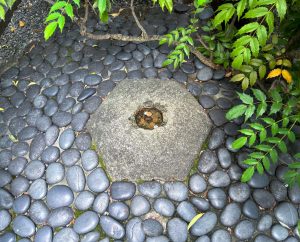
Photo: Photo AC
The "navel stone" is also known as the center of Kyoto.
Originally, Rokkakudo was said to be the center of Kyoto, and the "navel stone" is located there in reference to the navel at the center of the body.
This stone is hexagonal in shape, so take a look at it.
Fat Jizo
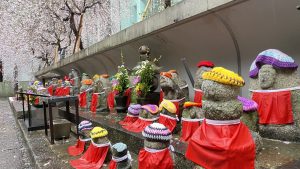
Photo: Photo AC
There are many Jizo statues in Rokkakudo.
Some places are large in size and have a variety of expressions, so they are sure to be relaxing to look at.
If you stand in front of the "One Wish Jizo" that grants one wish, you will want to join hands with it.
Fatty fortune
Rokkakudo's omikuji is very cute and features a dove.
Please try your luck!
Fatty Marriage Willow
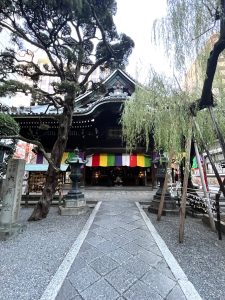
Photo: Photo AC
Rokkakudo is also a popular power spot for matchmaking.
It is said that Emperor Saga was once looking for a marriage partner when Nyoirin Kannon appeared to him in a dream and told him to "look under the willow tree in Rokkakudo.
He then followed the mysterious dream and went to the willow tree of Rokkakudo, where he found a beautiful woman and welcomed her as his wife.
This story has been passed down from generation to generation, and the hexagonal willow has come to be known as the willow of matchmaking.
It is said that if you tie two willow branches together and tie a omikuji, you will be blessed with a good marriage, and even today many women visit the shrine to tie their omikuji.
The birthplace of ikebana
Rokkakudo is also said to be the birthplace of ikebana, and the headmaster of Rokkakudo has been the headmaster of Ikenobo for generations.
■ Summary
How was it?
In this issue, we have introduced the history, highlights, and attractions of Rokkakudo in Kyoto.
Please visit Rokkakudo, located in the center of Kyoto and known as the birthplace of ikebana and the place associated with Prince Shotoku.
Facility Name:hexagonal building
HP:https://www.ikenobo.jp/rokkakudo/
Address: Dounomae-cho, Rokkaku-dori Higashinotoin Nishiiru, Nakagyo-ku, Kyoto-shi, Kyoto
Access: about 5 minutes walk from "Karasuma Station" of Hankyu Kyoto Main Line, about 3 minutes walk from "Karasuma Oike" of Kyoto Municipal Subway


Related PostRelated Articles
If you're going all the way, visit a place that will leave you with lasting memories! 7 Retro Cafés in Kyoto
Recently, retro-style coffee shops that make you feel as if you’ve slipped back in time to the Showa era have been attracting a lot of attention. With their vibrant colors […]
Detective Conan: A Pilgrimage to the Kyoto Locations Featured in "The Crimson Love Song" and "The Crossroads of the Labyrinth"! List [Summary]
The Detective Conan movies set in Kyoto are *A Crimson Love Letter* and *Crossroads in the Labyrinth* […]
What Is "Sawawa" in Kyoto? Discover the Charm of Matcha at Nishiki Market, with Over 1,300 Years of History!
Nishiki Market is often called the “kitchen of Kyoto,” and it’s lined with all kinds of shops, isn’t it? In a place like that, you can find drinks and ice cream made with matcha […]
"K-ON!" Kyoto Pilgrimage to the Series' Locations! List [Summary]
Have you heard of the anime “K-ON!”? “K-ON!” is a four-panel manga series by manga artist Kaki Furai […]
What is “Smart Coffee Shop,” a local favorite for many years? Their French toast is delicious!
Have you heard of a café called “Smart Coffee Shop” in Sanjo, Kyoto? It has been a local favorite for over 90 years […]