

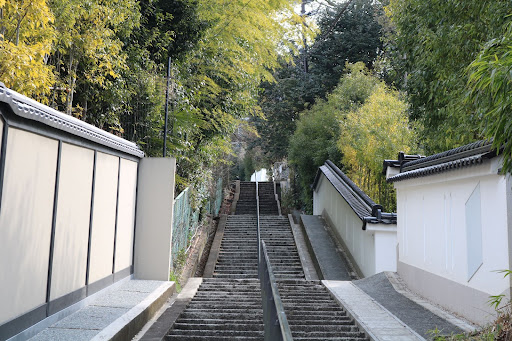
In 1853, Perry arrived in Uraga, and the movement to exclude the emperor and expel the barbarians became active in Japan. Kyoto was also the scene of upheaval at the end of the Edo period, and there are many spots in the city associated with the Shinsengumi, including the Yagi Residence, a place associated with the Shinsengumi, and Vinegar House, where Ryoma Sakamoto is said to have test-fired his pistol.
Although most of them are concentrated along the Kamo River, especially between Sanjo and Shijo, we dare to introduce here the "Restoration Path" in the vicinity of Kiyomizu-dera Temple, which is a hidden gem. The path is about 300 meters long and leads to the graves of Ryoma Sakamoto and Shintaro Nakaoka. If you are a fan of the end of the Tokugawa shogunate, you should definitely visit.
Table of Contents
- Get off at the nearest bus stop, Higashiyama Yasui, and go to the approach.
- Ryoma Sakamoto and Shintaro Nakaoka's graves are located at the Kyoto Reizan Gokoku Shrine.
- Reizan History Museum, which exhibits items related to the Sonno Joi movement.
- Ryoma-zaka," which is said to have been a path for the funerals of the late Bakumatsu samurai.
- Let's walk along the "Road of Restoration" while thinking about the turbulent period at the end of the Edo period.
Get off at the nearest bus stop, Higashiyama Yasui, and go to the approach.
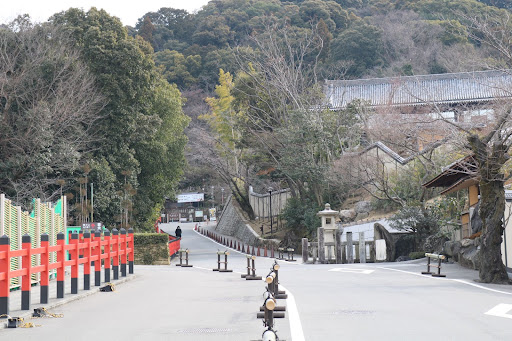
The entrance to Ishin-no-michi is located on the way up Kodaiji Minamidaimon-dori after getting off at the Higashiyama Yasui bus stop. On the right side, the path branches off to Ichinen-zaka and Ninen-zaka, but just keep going straight ahead. As you climb the steep hill, you will see a stone monument with the words "Restoration Path" written on it.
Ryoma Sakamoto and Shintaro Nakaoka's graves are located at the Kyoto Reizan Gokoku Shrine.
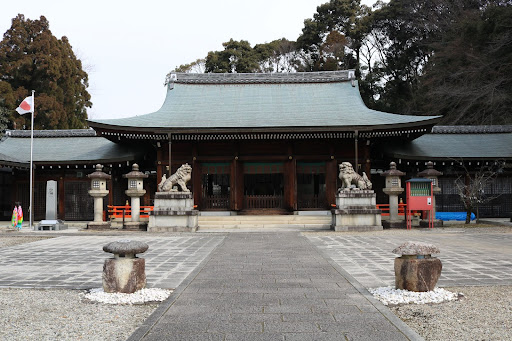
On the left side of the hill is the Kyoto Reizan Gokoku Shrine, where the graves of Ryoma Sakamoto and Shintaro Nakaoka are located. The shrine grounds are small, but there is a sense of tension in the air.
Visitors can enter the graves of Bakumatsu Shishi (late Edo period patriots) by paying a fee at the gate of the building near the entrance. The entire mountain is a cemetery, enshrining more than 1,300 Bakumatsu Shishi, including Kido Takayoshi, Takasugi Shinsaku, and Tokoro Ikutaro.
Name of facility: Kyoto Reizan Gokoku Jinja
Address: 1 Seikanji Reizan-cho, Higashiyama-ku, Kyoto, 605-0861, Japan
Phone number: (075) 561-7124
HP:http://www.gokoku.or.jp/
Reizan History Museum, which exhibits items related to the Sonno Joi movement.
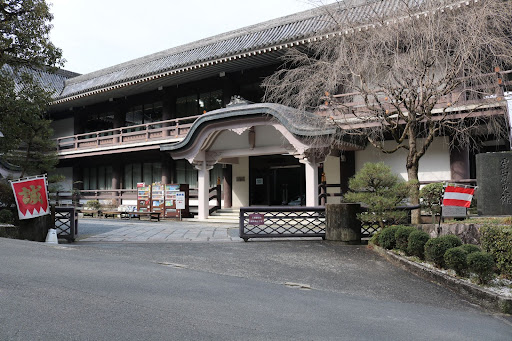
The Reizan Museum of History exhibits documents, armor, and clothing related to the end of the Tokugawa Shogunate and the Meiji Restoration. The museum also has a sword that is said to have slain Ryoma Sakamoto and chain mail armor actually worn by Isamu Kondo, making it a must-see for fans of the end of the Tokugawa shogunate!
Visitors can enjoy the museum with all five senses, such as touching the guns actually used in those days and seeing miniature reproductions of the Omiya Incident and the Ikedaya Incident. This museum will satisfy everyone from the slightly curious to the enthusiast.
Name of facility: Reizan History Museum
Address: 1 Seikanji Reizan-cho, Higashiyama-ku, Kyoto 605-0861, Japan
Phone number: 075-531-3773
HP:https://www.ryozen-museum.or.jp/
Ryoma-zaka," which is said to have been a path for the funerals of the late Bakumatsu samurai.
Further up from the Reizan History Museum, there is a narrow staircase on the right. This stairway is said to be the path that the bodies of Ryoma Sakamoto, Shintaro Nakaoka, and Tokichi Yamada were carried down when their funerals were held. After they died in an attack at "Omiya" in Kawaramachi, Kyoto, they were carried to the Reizan Cemetery through this path.
It is connected straight from east to west, down to Ninenzaka at the bottom and up to Shoboji Temple at the top. It is a fairly steep slope, so please try to climb it while taking a rest on the way up.
Let's walk along the "Road of Restoration" while thinking about the turbulent period at the end of the Edo period.
In this issue, we introduced the "Restoration Path" associated with the Bakumatsu no Shishi. Although nearby is Nichinenzaka, which is crowded with tourists, the area around the Restoration Path has a quiet atmosphere that makes one feel as if one's back is straightened. If you are interested in the history from the end of the Edo period to the Meiji Restoration, please visit.


Related PostRelated Articles

The signature dish at Muge Sanbo in Kyoto—the ”Ultra-Rich Matcha Parfait”—is absolutely delicious! If you want to experience the true essence of Kyoto, this is the place to go!
Have you heard of a shop called “Muge Sanbo,” whose signature dish is a parfait made with matcha that’s quintessentially Kyoto […]
"Rurouni Kenshin" Kyoto Pilgrimage to Famous Locations! List [Summary]
Have you heard of *Rurouni Kenshin*? Not only is there an anime series, but it’s also been adapted into a live-action movie starring Takeru Satoh, so you should definitely check it out […]
Who is Fujina Mi (Sannenzaka Main Store)? Her mitarashi dango are absolutely to die for♪
Have you heard of “Fujinami,” a shop famous for its mitarashi dango? Locals say this is the place to go for freshly made dango […]
A Pilgrimage to the Sacred Sites of "The Eccentric Family" in Kyoto! List [Summary]
Have you heard of the anime *The Eccentric Family*? *The Eccentric Family* is an anime adaptation of a novel by Tomihiko Morimi […]
Have you heard of “Minced Meat and Rice” in Higashiyama Ward, Kyoto? Is it true that it’s incredibly popular even though it only has one item on the menu?
Have you heard of “Hikuniku to Kome,” a famous hamburger steak restaurant in Tokyo? “Hikuniku to Kome” is a popular restaurant in Tokyo, and in 2022 […]