

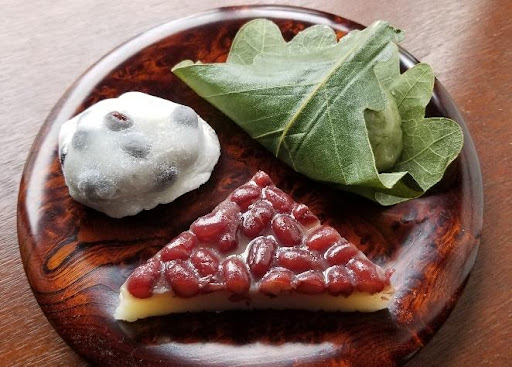
In this issue, we would like to introduce a wagashi (Japanese confectionery) that is served in Kyoto in June. Its name is "Mizunazuki.
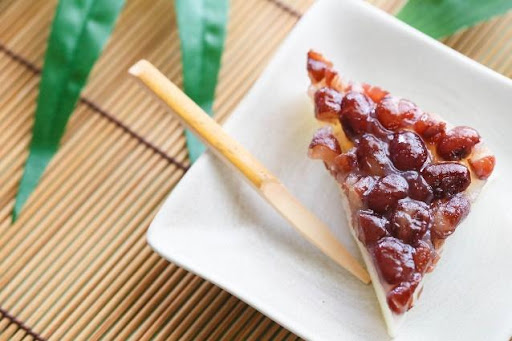
In late May, Mizumazuki begins to appear in Japanese confectionery stores in Kyoto. Mizunazuki is supposed to be eaten on June 30, but since it is sold at quite a variety of stores in June, many people probably eat it somewhere in June.
Just like the Hanabira Mochi for New Year's, I enjoy choosing a different store each year, "Which store should I go to this year?" I enjoy choosing Mizunazuki from different stores every year.
In addition, several years ago, I experienced making mizunazuki at a Japanese sweets making class for parents and children.
It did not turn out as beautifully as the ones at the store, but it was surprisingly easy to make using kamishinko and shiratama flour! Mizunazuki is a confectionery that has become a part of the daily life of the people of Kyoto.
summer purification rites (held at shrines on the last day of the 6th lunar month)
June 30, like New Year's Eve in December, is the day of purification and the turning point of the year.
In the imperial court, purification called "Oharae" was performed on the last day of the sixth month and the twelfth month of the lunar calendar. This event spread to shrines throughout Japan and is said to have become "Natsukoshi-no-harae" and "Toshikoshi-no-harae.
In Kyoto, large rings of thatch made from the grass family, Chigaya, are placed in front of the torii (gate) of various shrines.

The way to pass through the shrine differs from shrine to shrine, but it is generally done in a leftward, rightward, and leftward direction, as if drawing the character for "eight". Finally, it is common to enter the shrine by going straight through from the front. At some shrines, thatch is placed on the ground, and visitors can make their own small thatch rings to take home with them.
Some shrines also have an instrument for purification called a hitokatashiro. The human-shaped doll is meant to be used as one's alter ego to transfer one's own sins and impurities to the doll, which is then poured into water to purify it.
The manner of doing this also varies from shrine to shrine, but in general, one writes one's name and age on the ningyo-dai and pats the ningyo-dai from head to foot. This first causes the sins of the body to be attached to the ningyo-dai.

Next, by blowing on it, the sins of the mouth are possessed by the ningyo-dai. Finally, by holding the ningyo-dai in the hand and praying, the sins of the heart are said to be transferred.
I'll make love to you!
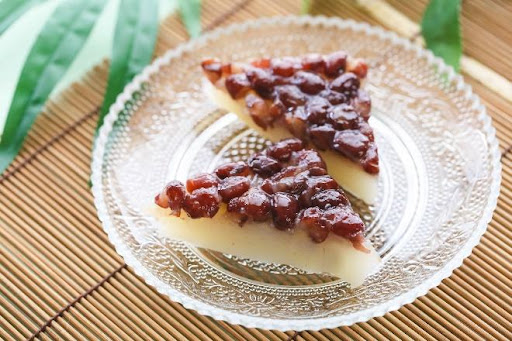
Mizunazuki" is a Japanese confectionery made of Uiro (steamed Uiro flour mixed with wheat flour and sugar) topped with azuki beans and other ingredients, steamed, and cut into triangles.
It is said that during the Heian period (794-1185), there was a custom at court to cut ice from the icehouse and eat it to ward off the heat on the "Hyoshitsu-no-Sekku" day, June 1 of the lunar calendar.
At the time when there was no ice-making technology, the public could not eat ice, so the custom of eating "mizunashi", which imitates ice, to feel cool began. It is also said that azuki beans are meant to ward off evil spirits.
When you try it, the chewy texture and gentle sweetness of the Uiro (sweet bean curd) is combined with the original aroma and flavor of azuki beans. You can also feel the coolness from the cool and refreshing texture.
Mizunashi" is that popular restaurant!
The following photo shows mizumazuki from Demachi Futaba, the most popular wagashi store in Kyoto, well known for its mame-mochi (bean cake).

The harmony of the chunky texture of the Uiro portion and the large, richly flavored Tanba Dainagon is irresistible! The overall sweetness is moderate, so you can enjoy the deliciousness of the ingredients, which is the same as with the bean cake.
Since it had been on sale since mid-May, I grabbed a piece of the Kashiwa Mochi as well.
And, of course, you can't leave without buying a bean cake, so the dreamy triangle of three bean paste dishes has been realized~.
In addition to the plain type, Futaba has a rich variety, including "brown sugar minazuki" made with Hateruma brown sugar, "green tea mizumazuki" with green tea Uiro topped with Uguisu amanatto, and mizumazuki with white azuki beans! I tend to buy all kinds (laugh)!
And another kind I recently had was from Tamadakan near Kuramaguchi Station.
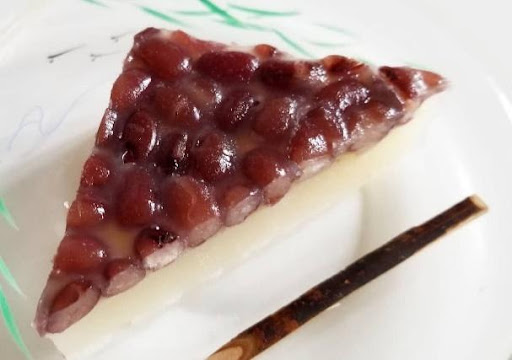
It has sharp corners and a beautiful look. It was more crisp than Futaba's Uiro, and the azuki beans were a little sweeter, perfect with matcha green tea.
Since they were made in an era when there was no air conditioning, they were devised to make the hot summers as comfortable as possible, and this ingenuity has been passed down to the present day as a Kyoto tradition.
The Kyoto people's deep love of Mizunazuki will probably continue to evolve and be passed down through the ages.
During the month of June, Mizumazuki will be all over Kyoto, so why don't you try it and enjoy searching for your favorite Mizumazuki?
■Demachi Futaba
Address: 236 Seiryu-cho, Imadegawa-agaru, Demachi, Kamigyo-ku, Kyoto-shi, Kyoto
■Access: 4 minutes walk from Demachiyanagi Station
Phone number: 075-231-1658
Business hours: 8:30 a.m. to 5:30 p.m.
Closed: Tuesdays and the 4th Wednesday of the month (or the following day if the day falls on a national holiday)
■bullet wound
Address: 253 Shin-Goryoguchi-cho, Karasuma Higashi-iru, Kuramaguchi-dori, Kita-ku, Kyoto-shi, Kyoto
■Access: 2 minutes walk from Kuramaguchi Station
Phone number: 075-231-3484
■Opening hours: 10:00-19:00
Closed: Thursday
*Business hours and services may vary.


Related PostRelated Articles

Detective Conan: A Pilgrimage to the Kyoto Locations Featured in "The Crimson Love Song" and "The Crossroads of the Labyrinth"! List [Summary]
The Detective Conan movies set in Kyoto are *A Crimson Love Letter* and *Crossroads in the Labyrinth* […]
"Rurouni Kenshin" Kyoto Pilgrimage to Famous Locations! List [Summary]
Have you heard of *Rurouni Kenshin*? Not only is there an anime series, but it’s also been adapted into a live-action movie starring Takeru Satoh, so you should definitely check it out […]
"K-ON!" Kyoto Pilgrimage to the Series' Locations! List [Summary]
Have you heard of the anime “K-ON!”? “K-ON!” is a four-panel manga series by manga artist Kaki Furai […]
A Pilgrimage to the Sacred Sites of "The Eccentric Family" in Kyoto! List [Summary]
Have you heard of the anime *The Eccentric Family*? *The Eccentric Family* is an anime adaptation of a novel by Tomihiko Morimi […]
What is “Fengquan,” a restaurant serving Kyoto-style Cantonese cuisine? If you’re looking for authentic flavors in Kyoto’s Nakagyo Ward, this is the place to go!
Have you heard of a restaurant called “Hōsen” in Kawaramachi, Kyoto? “Hōsen” is a restaurant where you can enjoy authentic Cantonese cuisine […]