

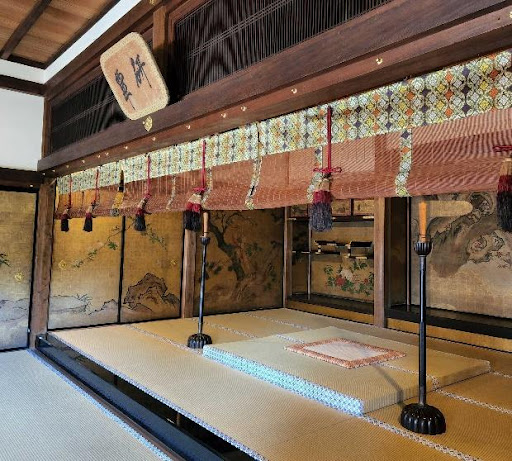
Did you know that Kyoto holds special openings of cultural properties twice a year, in spring and fall?
Officially known as the "Kyoto Special Open House of Undisclosed Cultural Properties," this is an educational program started in 1965 to promote the protection of cultural properties.
This year marks the 58th time that the event has been held with the cooperation of shrines, temples, and owners of cultural properties, with the hope that by opening these properties to the public, interest in cultural properties will grow.
In this issue, I would like to introduce two special open houses that I visited recently.
Reizei Family Residence

The first one I would like to introduce is the Reizei Family Residence.
Located just north of the Kyoto Gyoen, it was rebuilt in 1790. Normally closed to the public, it is open to the public for a few days each year.
The Reizei family is descended from the father and son Fujiwara Shunzei and Teika, poets who were active in the late Heian and Kamakura periods, and who selected poems for the Kokinshu (Anthology of Ancient and Modern Japanese Poetry).
Shunsei and Teika are well known poets in the Hyakunin Isshu.
After the Meiji Restoration, most of the court nobles moved to Tokyo, but the Reizei family remained in Kyoto, as they were responsible for the preservation and various affairs of the Kyoto Imperial Palace, and had a vast amount of books and other documents stored in the Imperial Library. As a result, the Reizei family was the last of the official residences to remain in Kyoto, and the only one to remain in its entirety, and is designated as an Important Cultural Property.
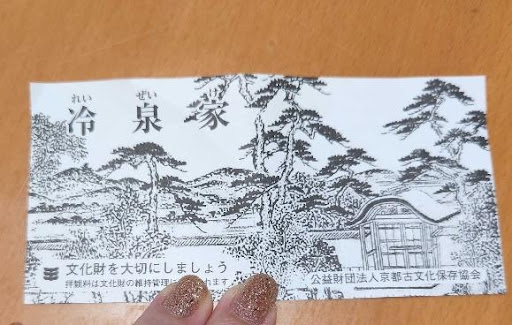
After passing through the gate, photography is not allowed, so I do not have any pictures of the inside of the building.
A large bundle of straw was displayed on the earthen floor of the kitchen.
These are called shaguma, or "red bears," and are straw ornaments attached to the top of the naginohoko floats during the Yamahoko procession of the Gion Festival.
Since when, the red bear of Nagatohoko is delivered every year after the parade is over and displayed on the earthen wall as an amulet to ward off evil spirits.
What surprised me in the tatami room wing was the simplicity of the wallpaper, which was a gold base with a light -toned arabesque pattern. In fact, there is a reason for that.
I heard that this is because when composing waka poems at poetry gatherings, wallpaper seasonal or assertive motifs would get in the way of the poems if they came into view. I realized that everything is considered with poetry at the center.
The most impressive part of the collection was the storerooms, including the large storehouse in the north.
The museum has a large collection of waka poem related items, including 5 national treasures, 48 important cultural properties, and tens of thousands of items, including 1,300 items!
They also have famous materials such as "Kokin Waka Shu" and "Meigetsu Ki" written by Fujiwara no Teika, which are introduced in textbooks. They are truly a treasure of Japan.
It is a valuable cultural asset that allows modern people with busy lifestyles to experience the noble culture, which can be said to be the starting point of Japanese culture.
The Reizei Family Residence is usually open to the public for only a few days each year, so although it will be closed in 2022, we encourage you to visit next year and beyond.
Facility Name:Reizei Family Residence
HP:https://reizeike.jp/
Address: 599 Genbucho, Kamigyo-ku, Kyoto-shi, Kyoto
TEL: 075-241-4322
Shogoin Monzai
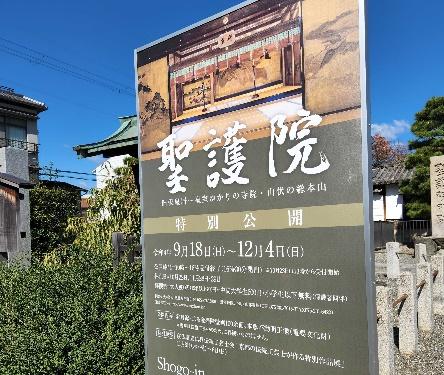
Another stop was the Shogoin Monzeki. During the special opening, visitors can take a 40-minute guided tour.
Shogoin Monzeki is the head temple of the Honzan Shugen sect in Sakyo-ku, Kyoto.
In recognition of his achievements, he was given a grant of land in the present-day Shogoin area, and also ordered to take charge of the Kumano Sanzan (three mountains of Kumano) and to supervise the Kumano Shugendo practitioners. In 1090, he founded Shogoin at this site as "the temple that protected the Sage.
It is a temple of Shugendo and mountain asceticism, and many Buddhas related to Shugendo are enshrined there.
In 1872, after the abolition of Shugendo, it temporarily belonged to the Tendai Teramon sect, but in 1946, it became independent again as the Shugendo sect (later the Honzan Shugendo sect), where it remains to this day.

Since the entry of Prince Shizue, son of Emperor Go-Shirakawa, into the temple as the Imperial Gate, the temple has been visited by successive generations of the Imperial Priests and boasts a high status as a temple for the Imperial Priests.
It was designated as a national historic site as the "Former Temporary Imperial Palace of Shogoin" due to its close ties with the Imperial Family, as it was twice used as a temporary imperial residence in the late Edo period.
The principal image is "Fudo Myoo" (Important Cultural Property), which was created in the late Heian period and has been protected from several fires in Shogoin.
(Photography was not allowed.)
Fudo Myoo is the central Myoo of the five great Myoo, the object of Buddhist faith, and is also called "O-fudo-san.
It is widely worshipped in the Shingon, Tendai, Zen, Nichiren, and other schools of Japanese Buddhism, as well as in the Shugendo sect.
The beauty of the figure, with its chest out and its stern stare majestic, was a sight to behold!
And most Fudo Myoo are accompanied by two children.
On the right is Kongara Doji, who is reverent of Buddhism and wears a lotus crown, robe, and robes. On the left is Seitaka Doji, who is considered to represent sexual vice and wears no robe but only a robe wrapped haphazardly around his neck and shoulders.
In addition, many statues of Fudo Myoo are still enshrined in the temple today because they were taken over from the temple that was abolished during the movement to abolish Buddhism. The best part of guided tours and special openings is that you can learn more about these things from the guides.
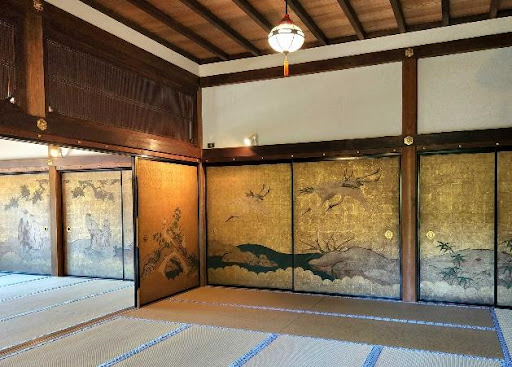
Another highlight of Shogoin is the gorgeous barrier paintings by the Kano school.
The shinkinden (Imperial Hall) houses more than 100 gold and blue paintings by Kano Einoh, son of Kano Sansetsu, and Kano Masunobu, adopted son of Kano Tanyu.
And the Upper Room, which was used by Emperor Koukaku as a temporary palace, is truly the world of a period drama.
It was like stepping back in time.
By listening to the guide's stories, the information and knowledge I had previously known were connected in my mind, and more than once, I found myself saying "I see! I was able to make connections between the information and knowledge I knew so far, and I was able to say "I see! It was a really good opportunity for me.
Facility Name:Shogoin Monzai
HP:https://www.shogoin.or.jp/
Address: 15 Shogoin Nakamachi, Sakyo-ku, Kyoto City
TEL: 075-771-1880
Delicious food in the Shogoin area (1)
After satisfying our appetite for knowledge, we went to "Meat Specialty Hafu Shogoin," a few minutes' walk from Shogoin Monzeki, for a delicious lunch. This is a branch of Hafu in Gosho Minami, a popular Western-style restaurant that has been frequently introduced on TV and other media.

Originally a butcher shop, the quality of the meat is second to none.
The order was also for "beef cutlet!
The inside is rare and so tender that you can cut it with a chopstick. When you put it in your mouth, the juicy flavor of the meat will spread in your mouth.
The batter around the dish is crispy, and the demi-glace sauce is rich and deep!
It was blissfully delicious... ♪
Facility Name:Meat Specialty Hafu Shogoin
HP:http://hafuu.com/
Address: 8 Sanno-cho, Shogoin, Sakyo-ku, Kyoto
TEL:075-708-8270
Delicious food in the Shogoin area (2)
The next stop was Shogoin Hachihashi Honten.
Shogoin Hachihashi was established in 1689 and has a history of more than 300 years.
I had purchased fresh yatsuhashi at Kyoto Station and other places, but this was my first visit to the main store.
The "noren" curtain gives the restaurant the atmosphere of a long-established restaurant.
Among a lineup of limited-edition autumn products using chestnuts, the one we had this time was "Kanele".

Cannaire" is the French word for "Nikki.
A thinly baked yatsuhashi is rolled thinly.
The crispy, thin texture is pleasantly chewy and much easier to eat than ordinary yatsuhashi, making it a favorite of children as well. In addition to the Nikki flavor, there is also a coffee flavor.
Lightweight and reasonably priced, with cute packaging, they make great Kyoto souvenirs.
Facility Name:Shogoin Hachihashi Head Office
HP:https://shogoin.co.jp/
Address: 6 Sanno-cho, Shogoin, Sakyo-ku, Kyoto
TEL: 075-752-1234
Delicious food in the Shogoin area (3)
Our last stop was La Vature.
It is no exaggeration to say that this is the most famous tarte tatin store in Japan.
The previous owner, Yuri Matsunaga, was a pioneer in the Japanese tarte tatin world, having recreated the taste of tarte tatin she had eaten in France. For nearly 50 years since its opening, it has been loved by many fans throughout Japan, and now her grandchildren have inherited the taste.

The interior of the restaurant is said to be inspired by "the good old days in Japan that yearned for Paris," creating a relaxed atmosphere.
You can also eat in, but this time we decided to take out.
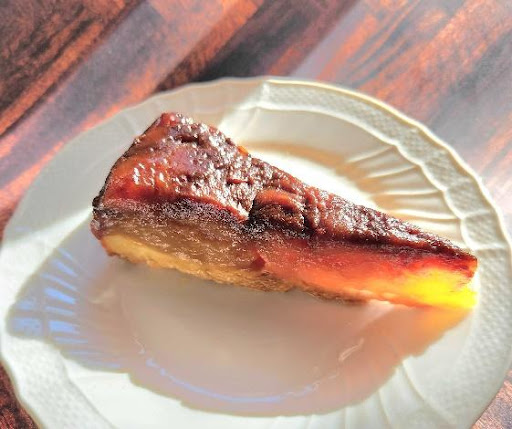
Here is the tarte tatin.
Tarte Tatin is a pastry that originated in France in the late 19th century.
It was born when the Tatin sisters, who owned a hotel, forgot the tart dough when making an apple tart and baked it with only apples, butter, and sugar. So Tarte Tatin was "a tart made by the Tatin sisters.
These tarte tatin are made with about 20 apples per hole.
Slowly caramelized for more than four hours, it has a deep taste of apple sweetness and tartness with a richness!
It is a taste unlike any other... ♪
If you eat in, it is served with yogurt sauce, but if you take it out, we recommend serving it with plain yogurt.
And the "walnut tart" that we took out with us was actually a masterpiece of taste.
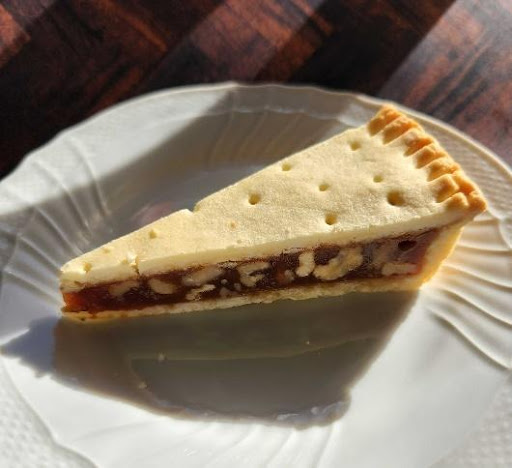
This was the first time I tried it, and the balance between the bitterness of the walnuts and the richness and sweetness of the caramel is exquisite!
Because of its strong bitterness, it is not suitable for children, but it was an excellent match for adult coffee.
Facility Name:La Vature
HP:https://voiture.buyshop.jp/
Address: 47-5 Entonbi-cho, Shogoin, Sakyo-ku, Kyoto
TEL: 075-751-0591
summary
The special open house at Shogoin Monzeki is relatively long and will run until December 4, 2022.
Information on other facilities is also available on the official website (http://www.kobunka.com/tokubetsu/) to check it out. We invite you to visit each facility for this special spring and fall-only opportunity!


Related PostRelated Articles
What’s so special about the luxurious tsukesoba at “Shamihōan” in Kyoto’s Higashiyama Ward? A historic restaurant with 161 years of history
"Shamihōan" has been a local favorite for over 100 years. This is a place where soba lovers can enjoy a meticulously crafted flavor that’s simply irresistible […]
"Rurouni Kenshin" Kyoto Pilgrimage to Famous Locations! List [Summary]
Have you heard of *Rurouni Kenshin*? Not only is there an anime series, but it’s also been adapted into a live-action movie starring Takeru Satoh, so you should definitely check it out […]
A Pilgrimage to the Sacred Sites of "The Eccentric Family" in Kyoto! List [Summary]
Have you heard of the anime *The Eccentric Family*? *The Eccentric Family* is an anime adaptation of a novel by Tomihiko Morimi […]
What is “Fengquan,” a restaurant serving Kyoto-style Cantonese cuisine? If you’re looking for authentic flavors in Kyoto’s Nakagyo Ward, this is the place to go!
Have you heard of a restaurant called “Hōsen” in Kawaramachi, Kyoto? “Hōsen” is a restaurant where you can enjoy authentic Cantonese cuisine […]
A Pilgrimage to the Sacred Sites of *Nurarihyon's Grandson: The Thousand-Year Demon Capital* in Kyoto! List [Summary]
"Nurarihyon's Grandson," a Japanese manga by Hiroshi Shiibashi. Serialized in Weekly Shonen Jump in 2008, it features yokai as its theme […]